Centre: Notifies opium poppy cultivation tracts, 2026-27
The Department of Revenue has specified cultivation tracts in Madhya Pradesh, Rajasthan, Uttar Pradesh and Uttarakhand for 2026-27. The notification does not itself grant farmers cultivation licences.
In this article
Listen to this article
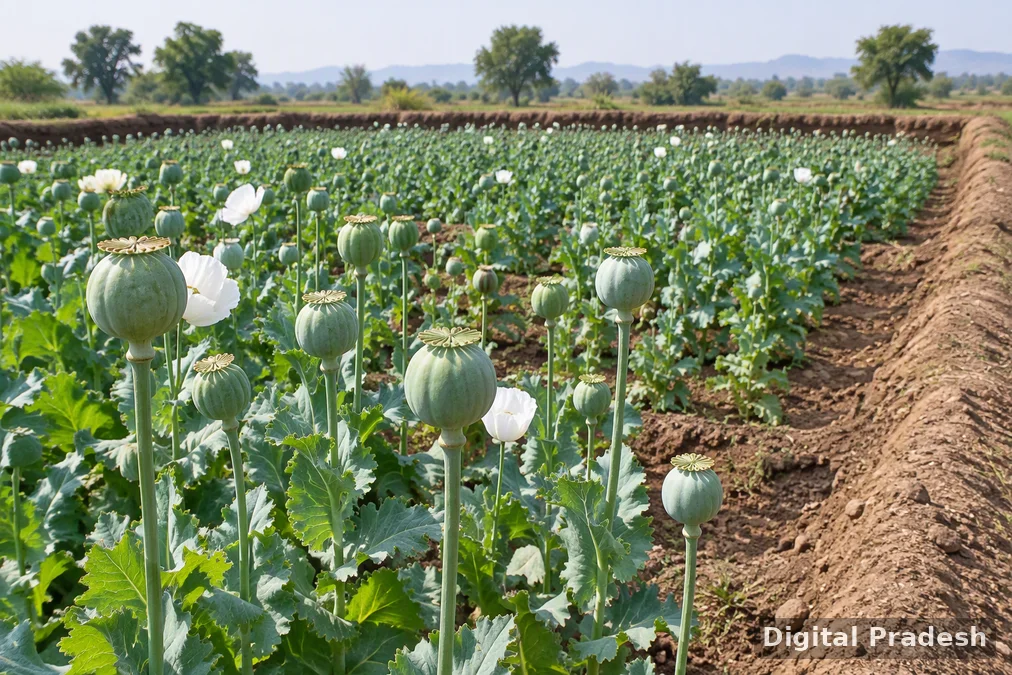
The Centre has specified the areas in Madhya Pradesh, Rajasthan, Uttar Pradesh and Uttarakhand where opium poppy cultivation may take place on its account for the 2026-27 crop year. The Ministry of Finance’s Department of Revenue issued the notification on 23 October 2026, covering the crop year from 1 October 2026 to 30 September 2027.
Notification No. 03/2026-NARCOTICS CONTROL-I, published as G.S.R. 914(E) in the Gazette of India, identifies permitted tracts by district and tehsil or pargana, rather than authorising cultivation across the four states. Both entries for Uttarakhand are marked for experimental cultivation.
The notification invokes Rule 5 of the Narcotic Drugs & Psychotropic Substances Rules, 1985, to designate these geographical areas. It is distinct from an individual farmer’s cultivation licence: the Department of Revenue’s account of licensed cultivation explains that the government separately notifies the areas where cultivation can be licensed and the general conditions for issuing licences.
Uttar Pradesh: specified tehsils and research institutions
The Uttar Pradesh section of the notification lists cultivation areas under the district names Barabanki, Lucknow, Faizabad, Shahjahanpur, Budaun, Bareilly, Ghazipur, Mau and Rai Bareilly. These are the district labels used in the Gazette table.
For Barabanki, the Department of Revenue lists Nawabganj, Ramnagar, Fatehpur, Ram Sanehi Ghat, Haidergarh and Sirouli Gauspur. Under Lucknow, it specifies Mohanlalganj alongside research institutions separately marked for experimental cultivation.
Those experimental entries are the National Botanical Research Institute (NBRI), Lucknow; the Central Institute of Medicinal & Aromatic Plants (CIMAP); and the CSIR-NBRI Maharishi Parashar Bioresource Centre at Banthara in Sarojani Nagar tehsil, according to the notification.
Under the heading Faizabad, the table names Sohawal, Rudauli, Bikapur and Milkipur. It also includes Acharya Narendra Dev University of Agriculture and Technology at Kumarganj in Milkipur tehsil, with the university entry marked experimental.
The notification specifies Kant in Sadar tehsil, Jalalabad, Kalan and Tilhar for Shahjahanpur. For Budaun, it lists Bisauli, Budaun, Dataganj and Bilsi; for Bareilly, it names Bareilly, Meerganj, Aonla and Faridpur.
The remaining Uttar Pradesh entries cover Zamania and Sevrai in Ghazipur, Ghosi and Madhuban in Mau, and Kumhrawan and Maharajganj under Rai Bareilly, according to the Gazette table.
Madhya Pradesh and Rajasthan tracts
In Madhya Pradesh, the notification identifies areas in Mandsaur, Neemuch, Ratlam, Agar Malwa, Ujjain, Jhabua and Rajgarh.
The Mandsaur entry covers Mandsaur, Dalauda, Sitamau, Suwasara, Malhargarh, Shamgarh, Garoth and Bhanpura. It also names KNK College of Horticulture, Mandsaur, for experimental cultivation, the Department of Revenue’s table states.
For Neemuch, the permitted tracts are Neemuch, Jawad, Manasa, Jeeran, Singoli and Rampura. The Ratlam entry comprises Ratlam, Sailana, Jaora, Alot, Piploda and Tal.
The notification also lists Badod and Susner in Agar Malwa; Mahidpur, Khachrod and Nagda in Ujjain; Petlavad in Jhabua; and Jeerapur in Rajgarh.
Rajasthan’s section covers specified areas in Kota, Baran, Jhalawar, Chittorgarh, Pratapgarh, Udaipur, Bhilwara, Shahpura and Salumber, according to the same notification.
For Kota, the table names Ramganjmandi, Sangod, Ladpura, Kanwas and Chechat. For Baran, it lists Baran, Chhabra, Chhipabarod and Atru.
The Jhalawar entry includes Jhalarapatan, Khanpur, Aklera, Manoharthana, Pirawa, Pachpahar, Gangdhar, Asnawar, Sunel, Dag, Raipur and Bakani. In Chittorgarh, the notification specifies Chittorgarh, Bhadesar, Dungla, Begun, Rawat Bhata, Nimbahera, Badi Sadari, Gangrar, Kapasan, Rashmi, Bhupal Sagar and Bassi.
For Pratapgarh, the listed tracts are Chhoti Sadari, Pratapgarh, Arnod, Dhariyabad, Pipalkhunt, Dalot and Suhagpura. The Udaipur entry covers Vallabhnagar, Bhinder, Kanod, Mavali and Udaipur, as well as Rajasthan College of Agriculture, Udaipur, which is marked experimental.
The Department of Revenue also specifies Mandalgarh, Bijoliya and Sawaipur in Bhilwara; Kotadi, Jahajpur and Kachhola in Shahpura; and Lasadiya in Salumber.
Uttarakhand entries are experimental
For Uttarakhand, the Gazette names CSIR-CIMAP at Pantnagar in Kichha tehsil of Udham Singh Nagar district and Vikasnagar in Dehradun district. Both entries carry the experimental designation.
That qualification distinguishes the Uttarakhand section from the other state sections, which list cultivation tracts alongside separately identified experimental institutions. The notification does not set out research objectives, experimental acreage or production targets for these entries.
Area notification is separate from licence approval
The Department of Revenue’s explanation of licensed opium cultivation describes a controlled system for medical and scientific purposes under the Narcotic Drugs and Psychotropic Substances Act. It identifies the Central Bureau of Narcotics (CBN), based in Gwalior, as the body responsible for licensing farmers, supervising cultivation and procuring the opium produced by licensed cultivators.
In the department’s description of the process, District Opium Officers issue cultivation licences under the general licensing conditions notified by the Centre for each crop year. Inclusion of a location in the Gazette table therefore establishes its place within the notified geography; it does not itself document the grant of a licence to any cultivator.
The CBN’s notifications page separately lists 2026-27 licensing policies for cultivation to obtain opium gum through lancing and for production of poppy straw from unlanced plants. The geographical notification does not supply the eligibility conditions for either policy. It also gives no farmer count, total licensed area, procurement price or minimum yield requirement.
The Department of Revenue describes field measurement as part of cultivation oversight: CBN officers measure individual farms to check that cultivation does not exceed the licensed area. Its account of opium-gum procurement says cultivators must tender their entire opium produce to the bureau and receive payment at government-determined rates.
The department further explains that procured opium goes to the government factories at Ghazipur and Neemuch. These facilities dry opium and extract alkaloids, including morphine, codeine and thebaine, for supply to the pharmaceutical industry.

Please log in to leave a comment.


