PM-KISAN: Rs 18,690 crore paid in 24th instalment
India released around Rs 18,690 crore under PM-KISAN on 30 October 2026, reaching more than 9.34 crore eligible farmers, according to PIB.
In this article
Listen to this article
The Government of India released around Rs 18,690 crore under the 24th instalment of the Pradhan Mantri Kisan Samman Nidhi (PM-KISAN) scheme on 30 October 2026 at Banaskantha in Gujarat, according to a Press Information Bureau (PIB) backgrounder issued that day. PIB said more than 9.34 crore eligible farmers received the assistance through direct transfers to their bank accounts.
The payment took cumulative disbursements under the scheme beyond Rs 4.64 lakh crore, PIB reported. Under PM-KISAN, each eligible farmer family receives Rs 6,000 annually in three equal instalments of Rs 2,000. The assistance is intended to supplement spending on agricultural inputs and household needs.
The release follows the Union Cabinet’s approval in July 2026 to continue the scheme from financial year 2026-27 through 2030-31, with a financial outlay of Rs 3.15 lakh crore, according to PIB. Its backgrounder also records a Union Budget allocation of Rs 60,000 crore for 2026-27. The multi-year outlay and annual allocation cover different periods; neither is the amount released in this instalment.
Release figures follow advance announcements
The Prime Minister’s Office had announced that Narendra Modi would release the instalment during his Gujarat visit, describing the planned payment in its announcement headline as around Rs 19,000 crore. That was an advance programme announcement, while PIB’s dated backgrounder reports the release as completed.
CNBC-TV18’s pre-event report put the expected transfer at more than Rs 18,680 crore. It reported that Gujarat Agriculture Minister Jitu Vaghani had announced preparations for the programme on 28 October.
These accounts describe the same instalment at different stages, but do not provide an explanation reconciling their amounts. PIB’s post-release account provides the basis for the disbursement figure reported here.
Family benefit linked to land records
PIB describes PM-KISAN as income support for eligible landholding farmer families with cultivable land. It says benefits depend on land records being linked to the scheme’s portal, bank accounts being linked to Aadhaar, and completion of electronic Know Your Customer verification, or e-KYC, which checks a beneficiary’s identity.
The Ministry of Agriculture and Farmers’ Welfare’s operational guidelines, revised on 21 June 2019, define a farmer family as a husband, wife and minor children who own cultivable land according to the relevant state or Union Territory’s land records. The benefit is therefore framed at the family level, rather than as a separate entitlement for every individual member.
Those guidelines set out exclusions for institutional landholders and certain higher-income or occupational categories. These include families with members who paid income tax in the previous assessment year, specified public officeholders and registered professionals practising in fields such as medicine, law and accountancy.
The guidelines also contain exceptions to some employment-related exclusions, including for Multi Tasking Staff, Class IV and Group D employees. Their wording is more qualified than a blanket exclusion of everyone associated with government employment.
PIB says the assistance supports purchases of seeds, fertilisers, irrigation equipment and agricultural machinery. It also attributes reduced dependence on informal credit and stronger household financial stability to the scheme. These are the government’s assessment of its effects; the backgrounder does not quantify those outcomes for the latest payment.
From registration to bank credit
PIB’s account of the payment process shows that registration is only the first stage. Farmers register through the PM-KISAN portal, its mobile application or Common Service Centres. State governments then verify eligibility and upload beneficiary details.
Aadhaar and bank details undergo validation, and ineligible applications are screened out. After final state approval, records go to the Public Financial Management System, the government platform used in the account-verification and payment process.
According to PIB, eligible records are used to generate fund-transfer requests and payment orders. The Department of Agriculture and Farmers Welfare issues sanction orders, after which sponsor banks and the National Payments Corporation of India process payments for credit to beneficiaries’ accounts.
States are also responsible for maintaining beneficiary records and preventing duplicate payments, PIB says. This makes the accuracy of land, identity and bank records part of the delivery process, alongside the release of funds by the Centre.
Digital verification and payment information
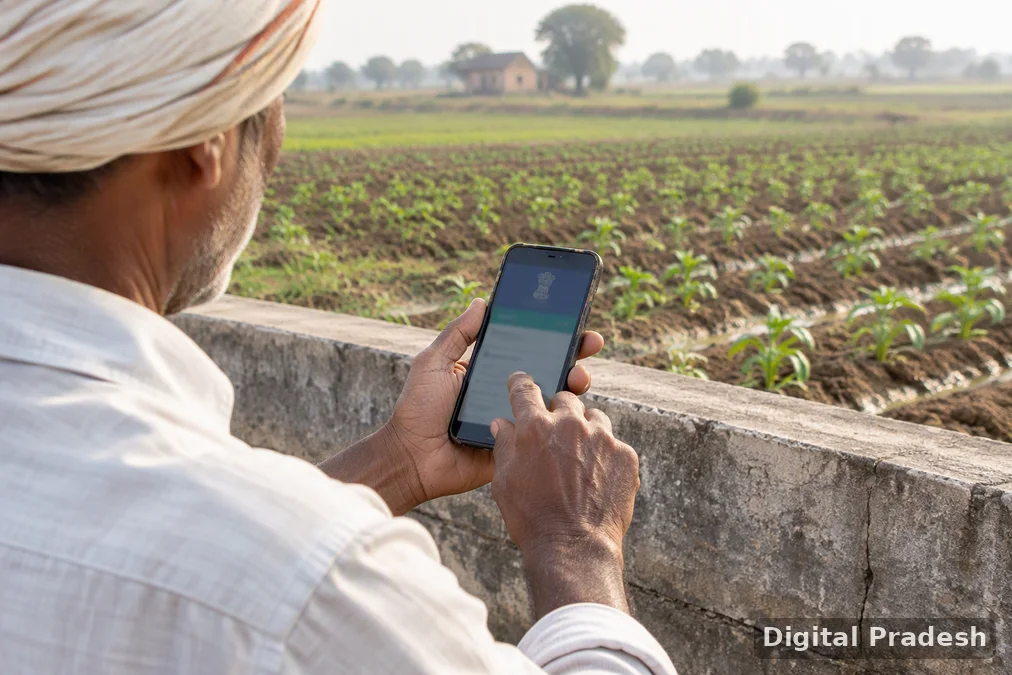
PIB lists three ways to complete e-KYC: authentication through a one-time password, biometrics or facial recognition. The PM-KISAN mobile application, launched in 2020, supports self-registration, payment-status tracking and identity verification.
The application gained facial authentication in 2023, according to PIB. This allows identity verification through a face scan rather than a one-time password or fingerprint.
The government also introduced Kisan-eMitra in September 2023, PIB says. The artificial intelligence-enabled chatbot was developed with technical support from the EkStep Foundation and BHASHINI and provides information on registration, eligibility and payments. It accepts voice and text queries and offers round-the-clock assistance in 11 languages.
Recovery and complaints remain part of administration
PIB says states and Union Territories undertake recovery proceedings where benefits have reached ineligible recipients. It records Rs 416.75 crore recovered nationwide as of December 2025. That is a historical recovery total, not a figure for the latest instalment.
Beneficiary lists are displayed at village level, according to PIB, allowing eligible families omitted from the database to seek inclusion through grievance mechanisms. Complaints can be registered through the PM-KISAN portal and the Centralized Public Grievance Redressal and Monitoring System, known as CPGRAMS.
PIB reports that the PM-KISAN portal recorded 24,605 grievances during financial year 2024-25. Its backgrounder does not state how many of those complaints were resolved or how many concerned delayed or withheld payments.

Please log in to leave a comment.


