CAQM: Industrial monitoring cameras due by 30 November 2026
Covered NCR industries must install operational monitoring cameras and connect live feeds to regulators by 30 November 2026. The expanded CAQM requirement supplements existing emission-monitoring obligations.
In this article
Listen to this article
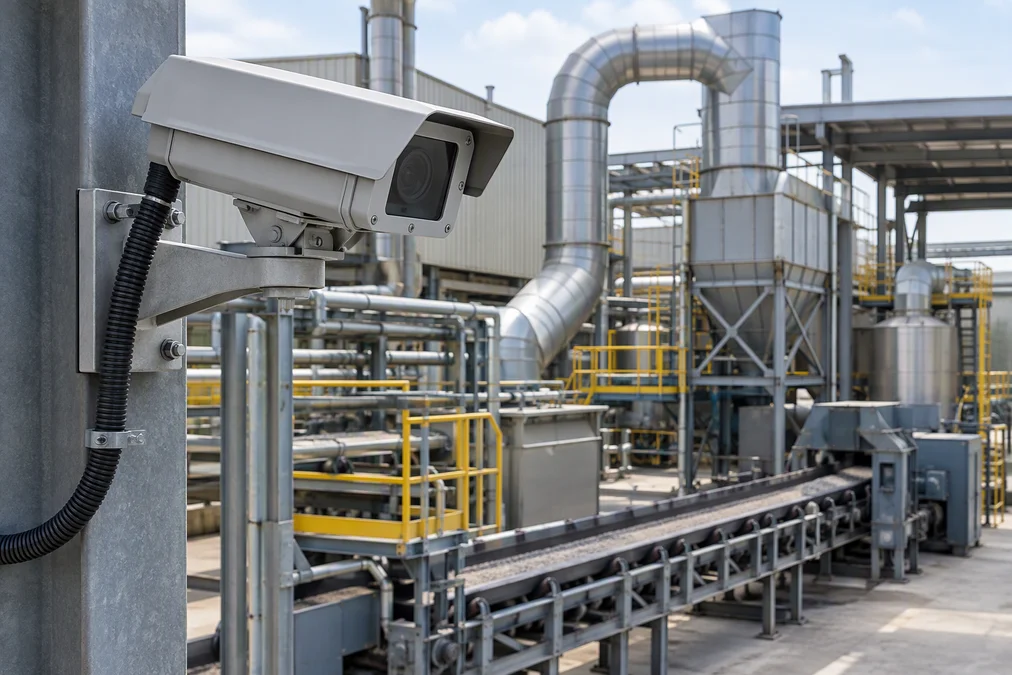
The Commission for Air Quality Management in NCR and Adjoining Areas (CAQM) has set 30 November 2026 as the deadline for covered industries in the National Capital Region (NCR) to install monitoring cameras and make their live video feeds accessible to pollution regulators. In a press release dated 16 October 2026, the commission said it had expanded the requirement to all industrial categories covered by Statutory Direction No. 98, superseding its order dated 5 October 2026.[1]
The requirement goes beyond purchasing and mounting cameras. Industrial units must have operational pan-tilt-zoom (PTZ) cameras, transmission arrangements, adequate power backup and functioning connections to the designated regulatory systems by the deadline. The cameras must cover specified fuel-use and emission-monitoring locations without significant blind spots.[1]
CAQM said its Flying Squads had reported instances of industries using unapproved fuels during inspections across NCR. The commission cited those reports as a reason for strengthening remote surveillance; the release does not identify the units involved or quantify those instances.[1]
Which industries fall within the requirement
The release identifies the covered groups as all 17 categories of highly polluting industries recognised by the Central Pollution Control Board (CPCB); medium and large Red Category air-polluting industries; food and food-processing and textile industries with boilers or thermic fluid heaters; and metal industries with furnaces, operating in NCR.[1]
The scope is therefore tied to specified industrial categories and equipment, rather than expressed as a blanket camera requirement for every business in NCR. The release does not give a total number of industrial units covered by the expanded order.[1]
An earlier account published by The Patriot quoted CAQM as requiring additional cameras by 31 October 2026. That report described coverage of stack emissions at textile and food-processing units with boilers, and fume-extraction and furnace-feeding areas at metal units.[2] The commission’s 16 October release expressly sets 30 November 2026 for the expanded requirement and states that the new order supersedes the 5 October order.[1]
Cameras must show fuel use as well as emissions
PTZ cameras can move horizontally, tilt vertically and zoom, allowing their view to be adjusted, as The Patriot explained in its report.[2] Under the expanded requirement, however, a camera’s ability to move does not remove the need for additional devices where one camera cannot adequately cover the prescribed locations.[1]
CAQM specifies different views according to the equipment and fuel used:
| Location or operation | Required camera coverage |
|---|---|
| Boilers, thermic fluid heaters, furnaces, kilns and other fuel-fired equipment | All applicable fuel-feeding or charging points, so fuel use can be monitored during operations |
| Equipment using gaseous fuels | Gas meters, gauges and associated metering arrangements |
| Industrial stacks and emission-monitoring equipment | Stack emissions and online continuous emission monitoring system sampling or port-hole locations |
| Fume-extraction systems | Relevant system areas, wherever applicable |
These locations, together with the requirement for adequate camera numbers and fields of view, are specified in CAQM’s release.[1]
The cameras must provide images clear enough to show the relevant operations, including at night where units operate during those hours. Coverage of gas meters also means that the requirements are not confined to premises feeding solid fuel into industrial equipment.[1]
Live connections and repairs are part of compliance
Video must be transmitted continuously through Real Time Streaming Protocol (RTSP), the specified method for delivering the live feeds. The destinations are designated servers or portals of CPCB and the respective State Pollution Control Boards (SPCBs) or the Delhi Pollution Control Committee (DPCC). Industrial units must keep the cameras and communication systems functional and accessible to those authorities.[1]
Responsibility for power supply extends to communication equipment and connectivity systems, not just the cameras. Units must provide suitable backup, maintain the equipment and restore service promptly after a malfunction or disruption.[1]
Any prolonged transmission disruption or malfunction must be reported promptly to the relevant SPCB or DPCC, together with the corrective action undertaken. The release does not define a numerical threshold for what counts as a prolonged disruption.[1]
Video surveillance does not replace emission measurement
CAQM expressly says the camera requirements are additional to existing obligations on emission standards, approved fuels, online continuous emission monitoring systems (OCEMS) and other pollution-control measures. Installing cameras therefore does not displace those separate requirements.[1]
The distinction is technical as well as procedural. CPCB’s Guidelines for Continuous Emission Monitoring Systems, published in July 2017, describe equipment that uses analytical measurements and computer processing to determine pollutant concentrations or emission rates. The guidelines also explain the need for calibration and quality checks to establish the validity of measurements.[3]
The expanded camera coverage supplies a view of operations, fuel-feeding locations and monitoring points. The continuous emission monitoring equipment supplies measurements. CAQM’s release retains both obligations rather than treating video footage as a substitute for emission data.[1][3]
CAQM said industrial emissions contribute to particulate pollution both directly and through the formation of secondary particles. Their impact becomes more prominent in winter, it said, when weather conditions restrict the dispersal of pollutants.[1]
Related coverage includes CAQM’s NCR inspection drive and its revised pollution-response schedule.
The receiving infrastructure remains a regulatory responsibility. CPCB, working with the state boards and DPCC, must arrange the portals, servers and other systems needed to receive and access industrial video feeds. The respective boards and DPCC must monitor compliance, while the governments of Haryana, Uttar Pradesh, Rajasthan and Delhi are also directed to ensure implementation. The release does not state whether all receiving systems are already operational.[1]
References
- Commission for Air Quality Management in NCR and Adjoining Areas. CAQM expands PTZ camera-based remote monitoring to all industries covered under Direction No. 98 for enhanced surveillance of fuel use, emissions and compliance in NCR; PTZ Cameras to be installed by 30th November 2026. 16 October 2026.
- The Patriot. NCR industries must install PTZ cameras: CAQM.
- Central Pollution Control Board. Guidelines for Continuous Emission Monitoring Systems. July 2017.

Please log in to leave a comment.