China seamless steel: Firms seek duty hike, levy change
Three Indian manufacturers sought higher duties and a change in the levy on specified seamless steel imports from China. The available DGTR text does not establish whether their request was accepted.
In this article
Listen to this article
The Directorate General of Trade Remedies (DGTR), in a final-findings document dated 23 October 2026, records a request by Jindal Saw Limited, Kirloskar Ferrous Industries Limited and Maharashtra Seamless Limited to increase anti-dumping duties on specified seamless steel products from China and change the form of the levy. The document sets out the background and procedure of a sunset review examining whether dumping and injury to Indian producers would continue or recur if the duties expired.
The available opening portion of the DGTR document does not contain its final recommendation or a proposed duty table. It therefore establishes the manufacturers’ request and the review process, but not whether the authority accepted their demand for higher duties.
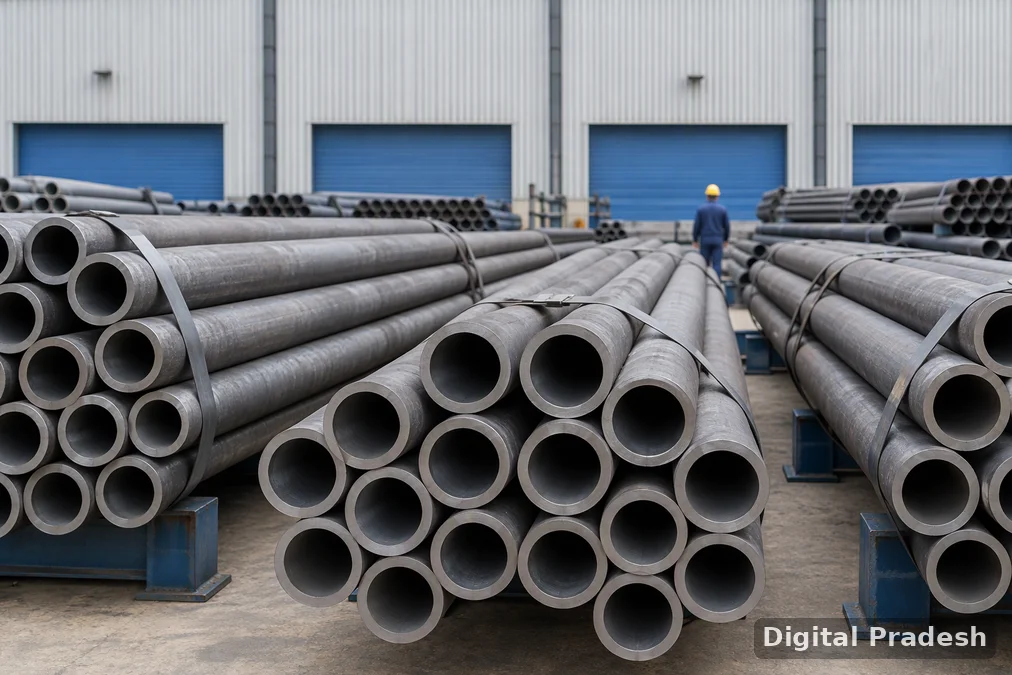
The review concerns seamless tubes, pipes and hollow profiles of iron, alloy or non-alloy steel originating in or exported from China. According to DGTR’s description, the products exclude cast iron and stainless steel and have an external diameter not exceeding 355.6 mm, or 14 inches. The description covers hot-finished, cold-drawn and cold-rolled products.
What the manufacturers sought
DGTR identifies the three applicants as the domestic industry seeking the review of the existing anti-dumping duty. Alongside that review, they sought both a modification of the duty’s form and an increase in its amount. The available text does not specify their proposed replacement structure or the increase requested.
A sunset review examines the case for retaining a duty as it approaches expiry. In this proceeding, DGTR said it initiated the review after finding prima facie evidence of the likelihood of continued or renewed dumping and injury. That was the initial evidentiary basis for opening the investigation, not the final conclusion.
The authority initiated the proceeding on 20 March 2026 under Section 9A(5) of the Customs Tariff Act, 1975, read with Rule 23(1B) of the anti-dumping rules. These are the provisions DGTR cited for conducting the sunset review.
The distinction between a recommendation and an imposed duty matters here. DGTR’s account of the earlier proceedings separates its findings from the subsequent customs notifications that gave effect to the levy.
How the earlier duty worked
The Ministry of Finance’s notification dated 17 February 2017, reproduced by Tax India Online, imposed the original definitive duty using a difference-based formula rather than a single flat charge on every covered shipment.
Under that notification, duty was payable when the imported goods’ landed value fell below the corresponding amount in the duty table. The charge equalled the gap between those values. The listed amounts ranged from US$961.33 to US$1,610.67 per metric tonne, depending on the product specification; they were reference amounts for the calculation, not uniform duty rates.
The notification defined landed value as the customs-assessed value plus customs duties, excluding specified categories of duty. Its table distinguished products such as tubing and casing used in oil or gas drilling, line pipes and bearing tubes.
The Hindu BusinessLine also reported that the duty continued after the first sunset review used a landed-value difference mechanism, with the same range of listed amounts. That historical structure provides context for the applicants’ present request to change the form of the levy, without establishing what alternative they proposed.
The investigation’s evidence period
DGTR’s October document says the current investigation covers imports during 1 October 2024 to 30 September 2025. Its examination of injury trends covers 2022-23, 2023-24, 2024-25 and that investigation period.
Those dates distinguish the evidence being assessed from the date of the final-findings document. The October 2026 document describes a review based on an earlier trading period, rather than import conditions measured in October itself.
DGTR said it obtained transaction-level import data from DG Systems and relied on that information after examining the transactions. It also said it verified information supplied by the domestic industry and other interested parties to the extent it considered necessary.
The authority described calculating a non-injurious price from the applicants’ production and selling-cost information. This is the domestic cost-based benchmark used in its injury analysis. DGTR said the calculation followed accounting principles and Annexure III of the anti-dumping rules, but the available portion gives no resulting price.
Exporter participation, but no importer responses
Jiangsu Chengde Steel Tube Share Co Ltd filed an exporter questionnaire response, according to DGTR. The authority had sent questionnaires to Chinese producers and exporters and asked China’s embassy in India to forward the notification and questionnaire to producers.
DGTR also sought information from known Indian importers and users, including Bharat Petroleum Corporation Limited, Indian Oil Corporation Limited and Reliance Industries Limited. The authority said none of the importers or users responded and participated in the review. Their absence is a procedural fact, not evidence that they supported the applicants’ request.
For its separate economic-interest exercise, DGTR received responses from the domestic industry and Jiangsu Chengde. It also shared that questionnaire with the Ministry of Steel.
The authority held an oral hearing on 9 June 2026 and directed participants to follow their presentations with written submissions and rejoinders. It said findings concerning parties that failed to provide necessary information were based on the facts available.
Earlier measures and the extension
DGTR traces the original investigation to 8 July 2015. Provisional duties followed on 17 May 2016, and definitive duties were imposed on 17 February 2017. The first sunset review began on 19 February 2021, with duties subsequently continued through the customs notification dated 28 October 2021.
For the present review, DGTR records a three-month extension under Notification No. 16/2026-Customs (ADD), dated 6 July 2026. The Ministry of Finance’s amendment, reproduced by TaxGuru, provides that the duty remains in force up to and including 27 January 2027, unless revoked, superseded or amended earlier.

Please log in to leave a comment.


