Dhubri district: CWC warns of river rise, boat curbs imposed
Dhubri restricted non-essential boat movements and mobilised emergency teams after a CWC warning. Officials reported no abnormal river rise and levels below the danger mark on 30 October.
In this article
Listen to this article
The Central Water Commission (CWC) warned of a possible sudden rise in river levels in Assam’s Dhubri district and West Bengal’s Alipurduar district in an advisory dated 29 October, following a reported glacial lake outburst in Bhutan, according to The Assam Tribune. Dhubri’s administration restricted boat movements and mobilised emergency personnel, but reported no abnormal rise in the rivers it was monitoring in the newspaper’s 30 October account.
News on AIR reported that the CWC issued the warning after the Indian Embassy in Bhutan conveyed a report of a Glacial Lake Outburst Flood at Shintaphu Lake. The term describes a flood resulting from water escaping from a glacial lake.
The CWC’s concern was the movement of floodwater through the Punatsangchhu river system, known as the Sankosh in India, according to News on AIR. Its report said local authorities along the Sankosh in both districts were advised to remain alert, monitor conditions and take precautions.
A border travel estimate, not a Dhubri arrival time
According to News on AIR’s account of the advisory, the CWC estimated that floodwater would take six to eight hours to reach the India-Bhutan border. The Assam Tribune reported the same estimate.
That interval referred to travel to the border, not a predicted arrival time in Dhubri. Neither account supplied a forecast peak water level for the district or a precise time when its river levels might rise.
The warning and the district’s subsequent observations also described different things: the CWC identified a possible downstream hazard, while local officials reported what they had observed.
Dhubri District Commissioner Dibakar Nath said there had been no abnormal rise in the Sankosh or Gangadhar rivers and that levels remained below the danger mark, according to The Assam Tribune’s 30 October report. He nevertheless said the administration was on high alert and urged residents not to panic.
Boat restrictions and emergency preparations
Nath said the district had activated its disaster preparedness machinery and was coordinating with the District Disaster Management Authority, police, water transport authorities and other departments, The Assam Tribune reported.
The newspaper said officials and response personnel had been deployed across vulnerable areas. Those involved included the Co-District Commissioner of Golakganj, officers from the Agomani and Golakganj revenue circles, disaster management field officers, and district and state disaster response personnel.
Five Indian Reserve Battalion boats were positioned under Golakganj and Tamarhat police stations, according to The Assam Tribune. Additional boats, including rubber boats, were mobilised from Goalpara and Bongaigaon to support emergency operations if needed.
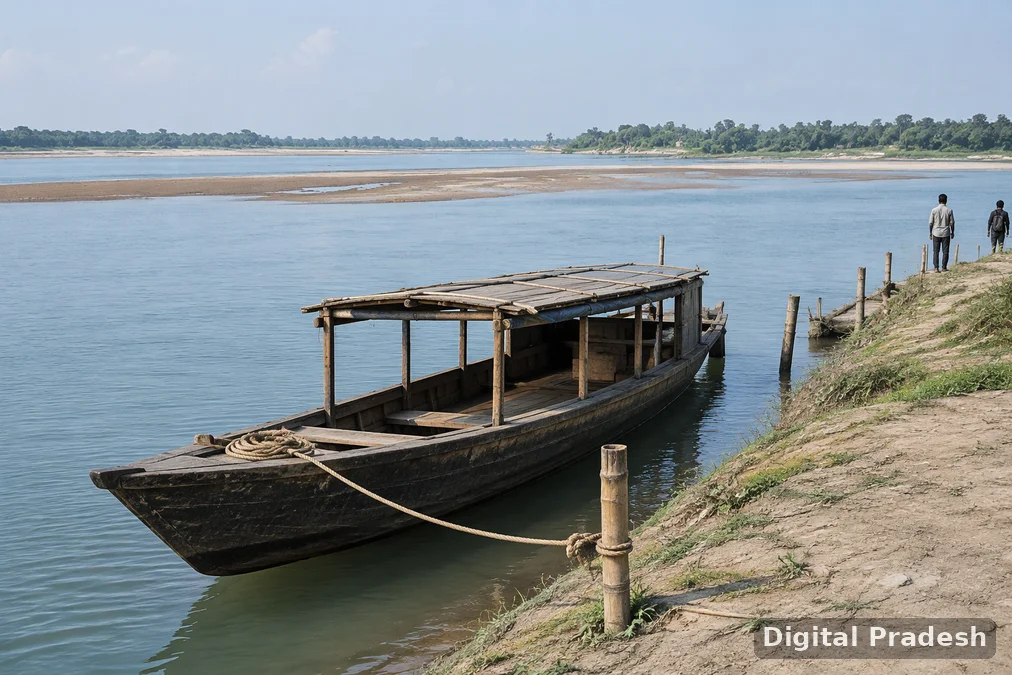
The restrictions had practical consequences for river transport. According to the newspaper, Inland Water Transport authorities were directed to restrict unnecessary boat movements, particularly at night. Daytime journeys were also to be avoided unless essential, with prior permission required from the relevant authorities.
The Water Resources Department was instructed to monitor embankments and identify potential risks, The Assam Tribune reported. The administration identified areas along the Sankosh and Gangadhar rivers as particularly vulnerable.
Residents of riverine and low-lying areas were asked to avoid fishing, bathing and other river activities, keep children away from riverbanks and remain prepared for a possible evacuation, according to the newspaper. These were precautionary instructions; the report did not describe an evacuation being ordered in Dhubri.
A special advisory does not establish a danger-level crossing
The CWC’s explanation of its flood-monitoring system distinguishes a warning about possible flooding from a classification based on measured river levels.
On its “Flood Forecasting/Hydrological Observation” page, the commission explains that flood categories depend on a forecasting site’s warning level, danger level and highest recorded flood level. These thresholds provide the reference points for describing conditions at that location.
Under the CWC’s classification, a river below its warning level is in the “Normal” category. A level at or above the warning threshold but below the danger threshold is “Above Normal”. A level reaching or crossing the danger threshold, but remaining below the highest recorded flood level, is “Severe”. Reaching or exceeding that historical high places it in the “Extreme” category.
Nath’s statement that the monitored rivers remained below the danger mark therefore did not, by itself, identify whether they were below or above their warning levels. The Assam Tribune account did not provide the gauge readings needed to make that distinction.
The CWC says its forecasts help administrations decide on measures such as evacuating people and moving property to safer locations. The purpose of an advance warning is thus to support preparations before the anticipated river conditions occur.
Bhutan’s wider glacial-lake monitoring
Bhutan’s National Centre for Hydrology and Meteorology documents the broader monitoring challenge in its “Bhutan Glacial Lake Inventory 2026”. The inventory records 620 glacial lakes across seven river sub-basins, compared with 567 in its 2021 inventory.
The centre reports that their combined area increased from approximately 55.04 square kilometres to 58.18 square kilometres. It associates the expansion with climate-driven glacier retreat and calls for continued monitoring of potential outburst-flood hazards.
The inventory combined Sentinel-2 satellite imagery with automated image analysis and expert manual checks, according to the centre. It recommends integrating satellite surveillance with field verification.
Those national findings provide background on Bhutan’s changing glacial lakes; they do not establish the volume of water released in the reported Shintaphu incident or the eventual downstream impact. For Dhubri, the documented response was precautionary mobilisation alongside Nath’s report of below-danger river levels on 30 October. The Assam Tribune report did not specify when the boat restrictions would be lifted.

Please log in to leave a comment.