CAQM: Stage III invoked in Delhi-NCR, AQI at 382
CAQM activated Stage III across Delhi-NCR ahead of forecast Severe air quality. Delhi's recorded AQI was 382, in the Very Poor category, and Stage I and II measures remain in force.
In this article
Listen to this article
The Commission for Air Quality Management (CAQM) invoked Stage III of the Graded Response Action Plan across Delhi-NCR with immediate effect on 6 November 2026, according to its press release issued that day. Delhi’s daily average Air Quality Index (AQI) stood at 382, in the “Very Poor” category, but forecasts indicated that air quality would deteriorate to “Severe” in the coming days, the Commission said.
CAQM said its sub-committee unanimously decided to activate the higher stage after reviewing air quality and forecasts from IMD and IITM. The Commission directed implementing agencies across the National Capital Region to enforce Stage III measures alongside Stage I and Stage II actions already in force.
The decision was preventive: the recorded AQI had not yet reached the Severe band. In its assessment, reproduced in the release, the sub-committee attributed the poor dispersion of pollutants to unfavourable meteorological conditions.
Why Stage III was invoked before AQI reached 401
CAQM’s GRAP schedule, revised on 29 September 2026, sets out progressively stronger responses to worsening air quality. Stage I corresponds to Delhi AQI of 201-300, Stage II to 301-400, Stage III to 401-450 and Stage IV to readings above 450.
Those bands do not require the authorities to wait for a threshold to be crossed. The schedule directs that stages be invoked in advance when weather and air-quality forecasts indicate that the corresponding higher pollution levels are likely to persist.
The 6 November decision therefore distinguishes the measured condition from the forecast: Delhi’s reported reading remained Very Poor, while the expected deterioration prompted the Severe-stage response. CAQM said the purpose was to prevent further worsening.
The Central Pollution Control Board’s explanation of the National Air Quality Index describes AQI as a way to convert complex pollution measurements into a single number and category. It calculates pollutant-specific sub-indices, with the worst sub-index determining the overall AQI. The figure of 382 was Delhi’s daily average reported by CAQM from the Board’s bulletin, not a forecast reading.
The revised GRAP schedule also provides for immediate activation of measures that can take effect at once if pollution unexpectedly crosses a threshold because of extreme weather or an episodic event.
Earlier controls continue alongside Stage III
CAQM’s announcement adds another layer of action rather than replacing the earlier stages. Digital Pradesh previously covered the invocation of GRAP Stage I across NCR and the subsequent Stage II response. The Commission’s latest release expressly retains both sets of measures.
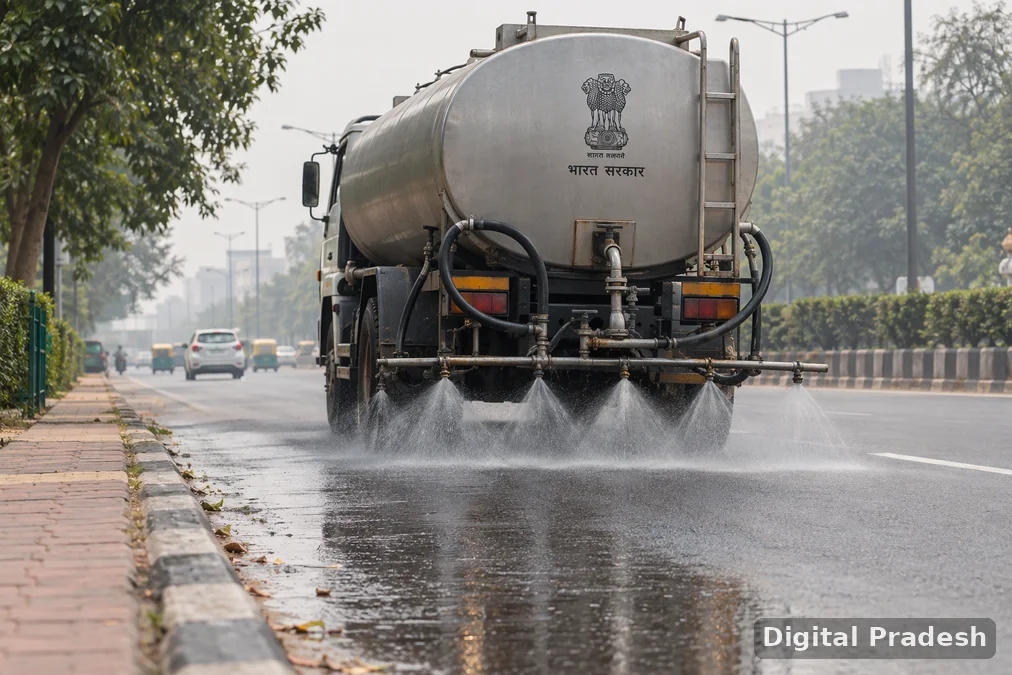
The revised schedule shows what that continuing baseline includes. Under Stage I, agencies must enforce dust-control requirements at construction and demolition sites, including covering materials and waste and using covered vehicles for their transport. Road-owning agencies must undertake mechanised sweeping and water sprinkling, with proper disposal of collected dust.
The schedule also requires enforcement against open burning of biomass and municipal waste, vigilance against fires at landfill sites, and regular removal of waste from designated dumping and industrial areas. Its transport provisions call for enforcement of vehicle pollution-certification requirements and action against visibly polluting vehicles.
For industry, the Stage I schedule requires inspections, compliance with emission standards and use of approved fuels. It also directs electricity distribution companies to minimise supply interruptions and says diesel generators must not serve as a regular source of power.
Responsibility extends beyond pollution regulators. CAQM’s Direction No. 104, dated 29 September 2026, requires the Delhi and NCR state governments, central departments, local bodies, development authorities and other agencies to enforce applicable measures within their jurisdictions when a stage is invoked.
The direction cites Section 12 of the Commission for Air Quality Management in National Capital Region and Adjoining Areas Act, 2021. As the direction explains, that provision empowers CAQM to take measures and issue directions to protect and improve regional air quality. It also requires project operators, industries, commercial establishments and other affected persons to comply with the relevant measures.
Citizen charter distinguishes requests from further instructions
In its 6 November release, CAQM urged residents to reduce short journeys, combine trips, choose cleaner transport and postpone private gatherings that increase traffic and outdoor exposure. These were presented as steps in the Stage III citizen charter, alongside the earlier-stage charter provisions.
The Commission also urged residents not to use coal or wood for heating. It suggested that homeowners provide electric heaters for security and other staff to avoid open burning of biomass, wood or municipal waste.
On education and employment, the release asked citizens to follow hybrid arrangements for primary schools and work-from-home arrangements “when instructed”. That conditional wording does not itself announce a universal switch for every school or workplace.
The Delhi government’s Department of Environment explains the weather mechanism in its 2023 inventory of major point air-pollution sources. During winter inversion, warmer air above cooler surface air limits vertical mixing, leaving pollutants less room to disperse. This is background to the dispersion problem, not a measurement of individual pollution sources on 6 November.
The same document describes prolonged exposure to Very Poor air as potentially causing respiratory illness, with more pronounced effects among people with lung and heart disease. It says Severe conditions can affect even healthy people.
CAQM said it would monitor air quality closely and review conditions regularly in the coming days. Its revised schedule separately requires chief secretaries in Delhi and the NCR states to review implementation frequently, particularly when air quality reaches, or is expected to reach, Severe or Severe+ levels.

Please log in to leave a comment.


