Samrat Choudhary: Orders inclusion of Rs 22,000 crore works
Bihar's chief minister has directed officials to include Rs 22,000 crore in rural development schemes under the mission. The direction does not establish that funds have been released or spent.
In this article
Listen to this article
Bihar Chief Minister Samrat Choudhary has directed officials to include schemes worth Rs 22,000 crore for village development and rural employment under the Viksit Bharat-Rozgar Evam Aajivika Guarantee Mission, according to Jagran. At a review meeting in Patna, he also called for the number of works taken up under the mission to rise from 1.5 lakh to three lakh, the newspaper reported.
The direction covers village infrastructure, water conservation, livelihood support and disaster management. Jagran reported that Choudhary asked departments to coordinate around villages’ basic needs and instructed district magistrates to monitor implementation regularly.
The reported decision is a direction to include projects under the mission, rather than an announcement that the full amount has been released or spent. Separately, Hindustan reported that Rural Development Minister Shravan Kumar, during a visit to Raxaul, described instructions to include approximately Rs 22,000 crore in development schemes under the programme.
Employment, wage payments and village facilities
According to Jagran’s account of the review, Choudhary said the mission provides rural families with a guarantee of 125 days of employment a year. The report described a funding arrangement in which the Centre and the state would contribute in a 60:40 ratio.
Choudhary asked officials to ensure that wages were paid within 15 days, Jagran reported. The employment guarantee and payment period were presented in the newspaper as features discussed at the meeting; its account did not provide detailed eligibility conditions or application procedures.
Rural Development Department Additional Chief Secretary H. R. Srinivas briefed the meeting on the mission’s features, work plan and implementation, according to Jagran. The chief minister said increasing employment opportunities should go alongside balanced development across villages.
The newspaper reported that the proposed facilities include anganwadi centres, schools, healthcare centres, rural markets and playgrounds for students, alongside plantation and water-conservation works. Anganwadi centres provide community-level childcare and related services.
For each anganwadi centre, Choudhary specified Rs 12 lakh for construction and a further Rs 2 lakh for furnishings, teaching materials and related items, according to Jagran. The report did not state how many centres would be built under these directions.
Jagran also reported that the chief minister asked officials to organise work around four categories: water security, rural infrastructure, livelihood enhancement and disaster management. He directed departments to give priority to completing facilities needed in villages, with district magistrates maintaining oversight.
Water conservation and rural markets
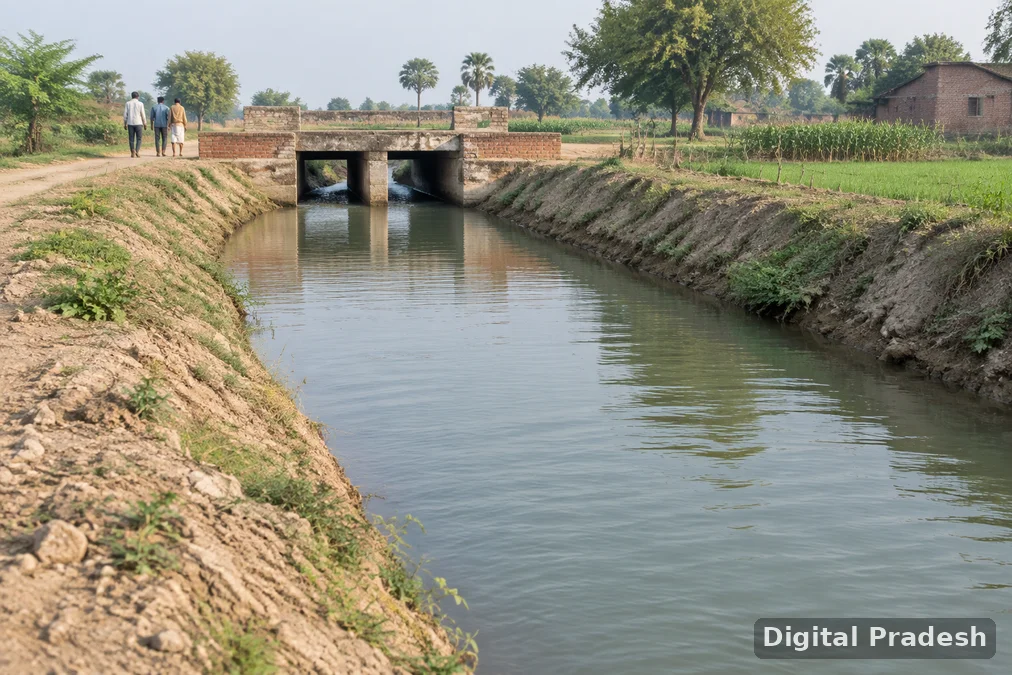
Restoring existing water infrastructure formed part of the review. According to Jagran, Choudhary called for priority repairs and restoration of canals, reservoirs and other water structures.
The newspaper reported that he linked this work to maintaining groundwater levels and meeting future water needs. He also asked the Environment, Forest and Climate Change Department to work towards its water-conservation and afforestation targets, with tree planting and water harvesting undertaken in coordination.
Hindustan’s report from Raxaul provided further detail on the government’s plans for rural facilities. Kumar said the state planned to develop playgrounds in 8,053 panchayats, the village-level local government bodies, but acknowledged that land disputes had affected construction at several locations.
According to Hindustan, Kumar also described plans for a Jeevika building and a rural market in every panchayat. He said the markets would give farmers a place to sell produce and women associated with Jeevika an outlet for products they make. His remarks set out the government’s intended benefits, rather than measured employment or income gains.
The same report described individual school projects in Lakshmipur Lachhumanwa panchayat in Raxaul block. Kumar inaugurated a boundary wall at Upgraded Middle School Lakshmipur, built at a cost of Rs 8,95,259 under the mission, Hindustan reported.
He also laid foundation stones for an additional classroom costing Rs 14,96,998 and a toilet costing Rs 2,15,863 at Newly Established Primary School Dih Tola, according to Hindustan. Those ceremonies marked the initiation of the two projects, not their completion.
What the budget establishes
Bihar’s Finance Department provides a separate fiscal context in its Budget Highlights for 2026-27. The document lists an annual scheme outlay of Rs 22,392.47 crore for the Rural Development Department, accounting for 18.33 per cent of the state’s total annual scheme outlay.
That is the largest departmental allocation in the document’s annual scheme outlay table. The Finance Department puts the total across departments at Rs 1,22,155.42 crore. These are budget estimates, not a record of expenditure already incurred.
The Rural Development Department’s allocation should not be treated as interchangeable with the Rs 22,000 crore project-inclusion direction reported by Jagran and Hindustan. The budget table identifies a department-wide annual outlay; the news reports describe works to be included under a particular mission. Neither report establishes how that proposed package maps onto the budget allocation.
The reports also leave the district-wise distribution of the proposed works and the schedule for completing the expanded programme unspecified. On implementation, Jagran reported a concrete instruction from Choudhary: district magistrates were to monitor the works regularly so that they were completed on time and to the required quality.

Please log in to leave a comment.