Supreme Court: Closes sales tax surcharge reference, cites GST
A seven-judge bench closed the constitutional reference on sales tax surcharges after GST changes made it academic. Individual disputes, including Punjab exemption and cess issues, remain open.
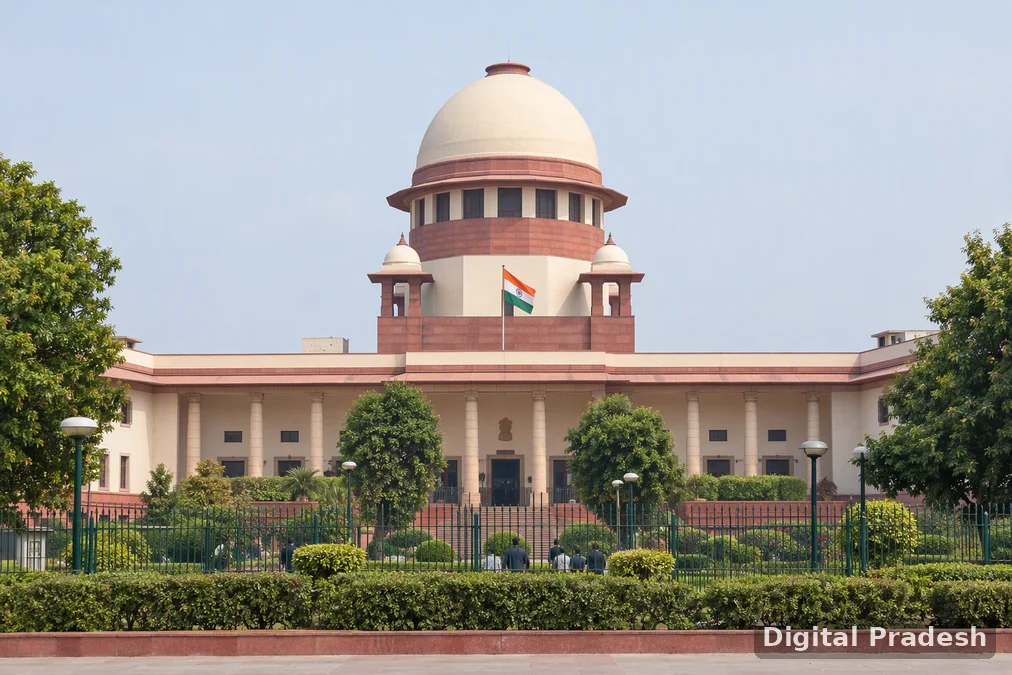
In this article
Listen to this article
The Supreme Court’s seven-judge Constitution Bench, headed by Chief Justice Surya Kant, has closed a long-pending reference on states’ power to impose additional charges calculated on sales tax, holding that changes brought by the Goods and Services Tax (GST) regime had made the question academic, LiveLaw reported. The decision on 4 November 2026 leaves individual tax disputes for a regular bench rather than disposing of every challenge in the batch.
According to LiveLaw, the court also clarified that a surcharge calculated as a percentage of sales tax payable remains an enhancement of sales tax under the constitutional provision applicable to these disputes. Its method of calculation does not, by itself, turn it into a tax on a dealer’s income.
The lead case, Arjun Flour Mills v. The State of Odisha Finance Department Secretary & Ors., concerns Section 5-A of the Orissa Sales Tax Act, 1947. The judgment identifies the central issue as legislative competence: whether a state had constitutional authority under the then Entry 54 of List II to calculate a levy on sales tax payable rather than directly on turnover.
The distinction between closing the constitutional reference and deciding the individual cases matters. LiveLaw reported that questions concerning exempt industrial units in Punjab, the handling of social security cess receipts, tax assessments and consequential relief were left open.
Why the calculation did not change the tax’s character
The judgment records the dealers’ argument that the disputed surcharge was a “tax on tax”. They submitted that Entry 54 authorised taxation of the sale or purchase of goods, not taxation of an existing tax liability. On their account, the surcharge instead fell on the dealer’s income or fiscal burden and exceeded the state’s powers.
The states argued that the surcharge merely increased the sales-tax rate for a specified class of dealers. According to the judgment, their position was that using the existing tax liability to calculate the additional amount did not change the underlying subject being taxed.
The judgment explains that, during the period relevant to the disputes, Entry 54 of the State List authorised taxes on the sale or purchase of goods other than newspapers, subject to Parliament’s powers over inter-state sales. It also notes that Article 265 requires a tax to have the authority of law, enacted by a legislature competent to impose it.
That framework separates what a tax falls on from how its amount is measured. The judgment states that the power to tax sales includes determining rates, distinguishing classes of dealers and prescribing methods of calculation, assessment and recovery.
In its account of the Odisha levy, the judgment says the surcharge depended on an existing sales-tax liability and increased or decreased with that liability. It did not arise independently of sales tax.
The judgment describes Section 5-A as imposing a surcharge of 10 per cent of total tax payable on dealers whose gross turnover exceeded Rs 10 lakh, effective from 1 July 1990. This differs from LiveLaw’s account, which describes a provision introduced in 1997 with rates of 10 and 15 per cent at different turnover levels. The available accounts do not reconcile those descriptions; the statutory scheme described here is the one set out in the judgment.
The earlier ruling that remained intact
The judgment identifies S. Kodar v. State of Kerala as an earlier Constitution Bench decision addressing the state’s power to impose an additional sales tax. It also records that the present dispute moved from a two-judge bench to a Constitution Bench and then to a seven-judge bench.
In S. Kodar, decided on 17 April 1974, the Supreme Court upheld the Tamil Nadu Additional Sales Tax Act, 1970, according to the judgment text reproduced by Indian Kanoon. The legislation increased the tax payable by dealers whose annual turnover exceeded Rs 10 lakh by an additional 5 per cent of their sales-tax liability.
The court held in that case that calculating the additional amount by reference to sales tax did not alter its character. It remained a tax on the aggregate sales made by the dealer, rather than a tax on income.
The S. Kodar judgment also rejected the argument that preventing dealers from passing the additional tax to purchasers changed its nature. The court held that a dealer’s right to recover a tax from a buyer was not an essential condition for the levy to qualify as sales tax.
According to LiveLaw, Justice K.V. Viswanathan’s separate opinion in the present case concluded that S. Kodar was correctly decided and remained good law. He found no conflict with Hoechst Pharmaceuticals Ltd. v. State of Bihar, which had upheld a sales-tax surcharge.
The perceived conflict also involved India Cement Ltd. v. State of Tamil Nadu, a case concerning a cess linked to mining royalty. LiveLaw reported that the present bench explained that India Cement did not establish a general rule invalidating a levy merely because it was calculated as a percentage of another tax.
According to LiveLaw’s account of the conclusions, the premise in India Cement that royalty was a tax had since been overruled by the larger bench in Mineral Area Development Authority v. Steel Authority of India. The court therefore found no surviving conflict requiring the reference to be adjudicated by seven judges.
Punjab’s separate questions remain unresolved
The judgment distinguishes two Punjab disputes from the basic question about states’ taxing powers.
Under Section 5(1-C) of the Punjab General Sales Tax Act, 1948, the judgment records a surcharge of 10 per cent calculated on sales tax payable. Section 30-AA introduced a separate complication: industrial units otherwise exempt from sales tax under Section 30-A were nevertheless required to pay the surcharge.
The question was therefore not simply whether a surcharge could be measured by sales tax. It was whether such a surcharge could apply when an exemption meant the industrial unit had no sales-tax liability. The judgment records that the Punjab and Haryana High Court upheld both provisions; LiveLaw reported that the Supreme Court left this specific issue open.
The other dispute concerns the Punjab Social Security Act, 2000. According to the judgment, the state imposed a cess, an earmarked levy, calculated as a percentage of sales tax payable to fund social security measures.
The Punjab and Haryana High Court struck down that enactment on grounds including the direct crediting of receipts to the Punjab Social Security Fund without first bringing them into the state’s Consolidated Fund under Article 266. Punjab challenged those judgments, the Supreme Court’s judgment records.
That issue concerns the constitutional route for receiving and appropriating state revenue, not merely the authority to impose the levy. LiveLaw reported that it, too, remained open.
According to LiveLaw, the Supreme Court directed its Registry to place the lead case and connected matters before an appropriate regular bench. That bench will consider the remaining disputes, including assessments and consequential relief, in accordance with the Constitution Bench’s observations.

Please log in to leave a comment.