IFSCA: GPUs eligible for operating leases, scope defined
IFSCA has specified GPUs and directly associated equipment as eligible for operating and hybrid leases under the IFSC framework, excluding assets serving an entire data centre.
In this article
Listen to this article
The International Financial Services Centres Authority (IFSCA) has specified graphics processing units (GPUs) and connected data centre equipment as assets eligible for operating leases, including arrangements combining operating and financial leases, under the IFSC financial-products framework. Its notification, reproduced by TaxGuru, limits connected equipment to assets dedicated to and directly associated with GPUs, excluding equipment serving a data centre facility as a whole.
The notification brings computing hardware within a framework established by the Ministry of Finance for leasing specified products and equipment. It follows an IFSCA proposal reported by The Hindu BusinessLine that sought to develop a financing channel for artificial intelligence infrastructure at GIFT City in Gujarat.
The distinction between dedicated computing equipment and wider facility infrastructure matters to the scope of the measure. IFSCA’s notification covers more than individual processors, but it does not make every asset used in a data centre eligible.
How the financial-product recognition works
The legal basis combines a Central Government notification with IFSCA’s specification of eligible equipment.
Section 3(1)(d)(vi) of the International Financial Services Centres Authority Act, 2019 allows the Central Government to notify additional products or instruments as financial products. The Act, available through India Code, applies to International Financial Services Centres established under Section 18 of the Special Economic Zones Act, 2005.
The Ministry of Finance exercised that power through notification S.O. 5199(E), dated 14 December 2021. It recognised operating leases, including hybrids of operating and financial leases, of products or equipment specified by IFSCA as financial products.
IFSCA’s GPU notification, numbered IFSCA/GN/2026/017, invokes that earlier notification together with Section 12 of the IFSCA Act. It specifies GPUs and connected data centre equipment for the purposes of the existing recognition.
In other words, the Ministry’s notification established the financial-product category, while IFSCA’s notification identifies the computing assets covered by it. The GPU notification states that it takes effect on publication in the Official Gazette.
There is an earlier precedent for recognising equipment leases under the Act. Through notification S.O. 3652(E), dated 16 October 2020, the Ministry of Finance recognised aircraft leases, including operating, financial and hybrid leases of aircraft, helicopters, engines and other parts, as financial products. That aircraft notification expressly covered financial leases as well as operating leases; the 2021 framework invoked for GPUs refers to operating leases and hybrids.
Coverage extends from processors to rack-scale systems
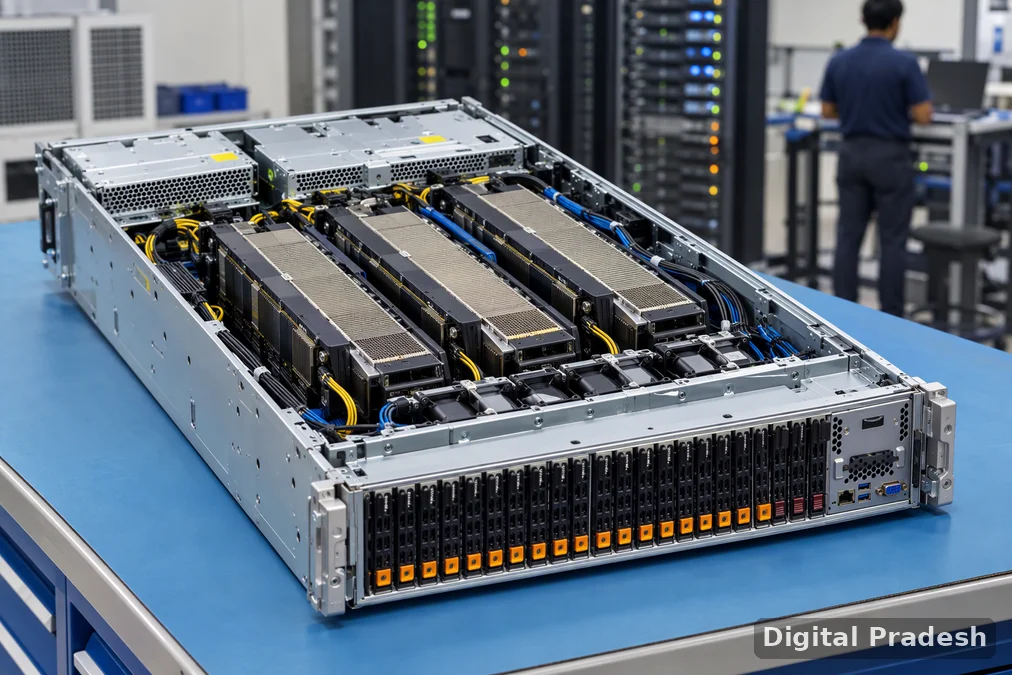
IFSCA’s GPU definition is not confined to conventional graphics processors. The notification reproduced by TaxGuru also includes general-purpose GPUs, artificial intelligence accelerators, tensor or neural processing units, accelerated computing equipment and comparable computing or acceleration technologies.
These are categories of hardware used to carry out computing tasks. By naming several types and including comparable technologies, the notification extends its scope beyond equipment sold specifically under the GPU label.
The definition also covers rack-scale artificial intelligence systems: systems integrating compute trays, switch trays, central processing units and input or output units within a single rack. IFSCA specifies that these systems can qualify whether or not they are supplied or invoiced as one integrated system.
For connected data centre equipment, the notification lists electronic integrated circuits comprising processors and controllers, including combinations with memory and other circuits. It also covers servers, storage, networking, interconnect and power equipment, including server power-supply units, alongside relevant parts and accessories.
That list is subject to a qualification: the connected equipment must be dedicated to and directly associated with GPUs. The notification expressly excludes equipment serving the data centre facility as a whole. Its coverage therefore depends not just on what an asset is called, but on its relationship to the GPU equipment.
The proposal’s financing rationale
The Hindu BusinessLine reported that IFSCA proposed the framework after stakeholders sought clarity on whether operating leases of GPUs and related equipment were permissible from an IFSC.
According to the publication’s account of the consultation paper, IFSCA envisaged financial institutions holding equipment either through ownership or a lease-in-lease-out arrangement. In the latter structure, an institution would lease equipment from another party and then lease it onward to users.
IFSCA’s stated rationale was that leasing could replace a large upfront hardware investment with periodic payments, The Hindu BusinessLine reported. The regulator also described a role for specialised lessors in taking on technology-obsolescence risk and residual-value risk: the risk that equipment becomes outdated and uncertainty over its value after a lease.
Those were the regulator’s reasons for proposing the framework, not demonstrated outcomes of the notification.
The consultation’s scale estimates were also forecasts. According to The Hindu BusinessLine, IFSCA estimated that deploying 650,000-700,000 GPUs in Indian data centres over the following five years could create an investment opportunity of about $23 billion. That estimate should not be read as investment already committed under the leasing framework.
Equipment leasing is distinct from shared computing access
The consultation also distinguished an equipment lease from GPU-as-a-Service, according to The Hindu BusinessLine. Under the proposed leasing model, a user would control identified GPU equipment. Under GPU-as-a-Service, a customer would pay for computing capacity from a shared pool, with the provider able to substitute the underlying hardware.
That distinction explains why financing identified assets and purchasing access to computing capacity were treated separately in the proposal. The notification reproduced by TaxGuru specifies eligible equipment; it does not itself set out that full service-model comparison.
The proposal had also expressly discussed cooling systems, chillers and dedicated power-distribution equipment, The Hindu BusinessLine reported. The notified text instead makes the connection to GPUs decisive for associated equipment and expressly leaves out assets serving the data centre facility as a whole.

Please log in to leave a comment.


