CAQM: GRAP Stage II invoked in NCR, Delhi AQI at 324
CAQM invoked GRAP Stage II across NCR, requiring stronger dust control, higher parking fees and staggered public-office hours in specified areas. Stage I measures remain in force.
In this article
Listen to this article
The Commission for Air Quality Management (CAQM) announced the invocation of GRAP Stage II across the National Capital Region with immediate effect on 2 November 2026, after Delhi’s daily average Air Quality Index reached 324. In its press release that day, the Commission said the reading fell in the “Very Poor” category and that the additional measures would apply alongside Stage I actions already in force.
The decision requires intensified road-dust control, higher vehicle parking fees and staggered public-office timings in specified areas, according to CAQM. Its sub-committee unanimously approved the escalation after reviewing air quality and forecasts at its 2 November meeting.
GRAP, the Graded Response Action Plan, sets out preventive and restrictive measures for different levels of air pollution. CAQM’s Direction No. 104, dated 29 September 2026, revised its schedule under Section 12 of the Commission for Air Quality Management in National Capital Region and Adjoining Areas Act, 2021. The direction describes that section as empowering the Commission to issue measures to protect and improve air quality.
Delhi’s worsening readings prompted escalation
CAQM’s release cited the Central Pollution Control Board’s daily bulletin for the 324 reading on 2 November. The sub-committee recorded a rise from 117, in the “Moderate” category, on 31 October 2026 to 261, in the “Poor” category, on 1 November.
The sub-committee attributed the deterioration to unfavourable meteorological conditions. According to CAQM, forecasts supplied by IMD/IITM indicated that Delhi’s air quality was likely to remain “Very Poor” in the coming days. That was the forecast considered at the meeting, rather than a record of subsequent conditions.
The Commission identifies Stage II with Delhi AQI readings of 301-400. Although Delhi’s readings informed the decision, CAQM announced the measures for the entire NCR, not just the capital.
The escalation added to, rather than replaced, the earlier Stage I measures across NCR. CAQM advised the NCR states’ pollution control boards and the Delhi Pollution Control Committee to ensure strict implementation of both stages.
AQI is an index, not a concentration reading for a single pollutant. The Delhi government’s Department of Environment explains on its AQI portal that the index converts pollutant measurements into a numerical scale, with station-level readings determined by the highest eligible pollutant sub-index. The portal also distinguishes hourly readings from the time its data feed was checked and describes real-time figures as provisional. The figure cited in CAQM’s announcement was specifically the CPCB daily average.
Road dust, parking charges and office hours
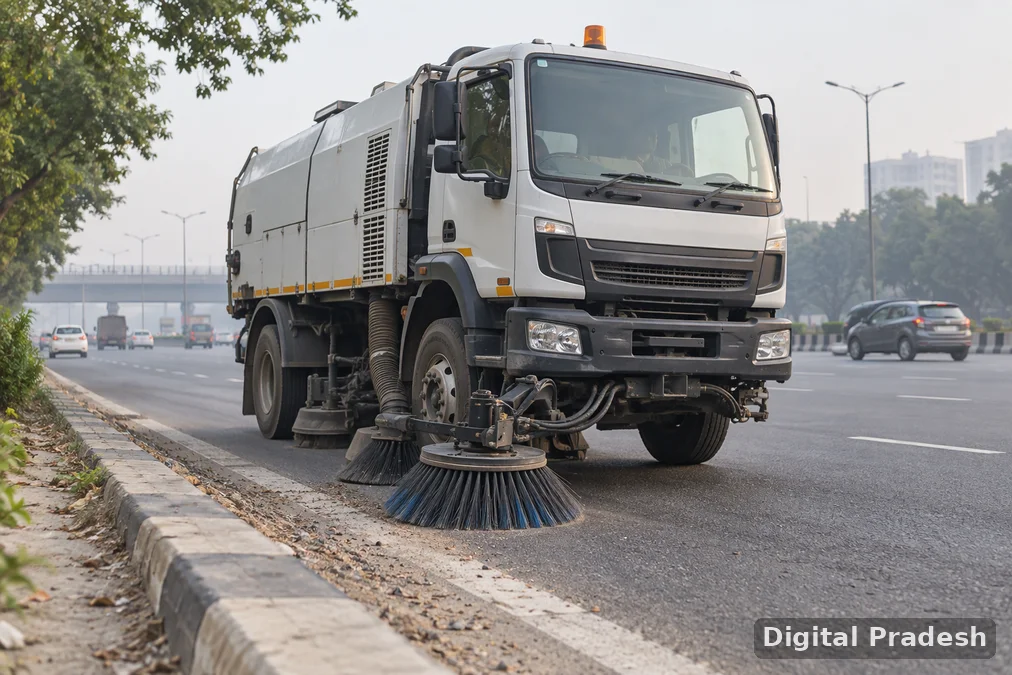
The eight agency measures listed in CAQM’s release include daily mechanical or vacuum sweeping and water sprinkling on identified roads, preferably at night or early in the morning. Agencies are to increase machine deployment hours or shifts and dispose of collected dust at designated sites or landfills.
CAQM also requires daily sprinkling with dust suppressants before peak traffic hours on roads and rights of way, particularly heavily trafficked corridors and congestion points. These are accompanied by targeted action at identified pollution hotspots, focusing on the sectors contributing to poor air quality at each location.
At construction and demolition sites, the Commission calls for more inspections to enforce dust-control requirements. The agency action listed in the release is intensified enforcement of those requirements, rather than a blanket construction shutdown.
For transport, CAQM’s Stage II list requires increased vehicle parking fees to discourage private transport. The release does not specify revised rates or report that individual parking authorities had introduced them.
The office-hours provisions distinguish between mandatory action in named areas and decisions left to governments. CAQM directs the Delhi and NCR state governments to stagger timings for public offices and municipal bodies in Delhi and the districts of Gurugram, Faridabad, Ghaziabad and Gautam Buddha Nagar.
For other NCR areas, the release says state governments may decide whether to stagger those timings. It separately leaves the Central Government to decide on staggered hours for its offices in Delhi-NCR. No specific opening or closing times appear in the announcement.
CAQM also requires resident welfare associations to provide electric heaters, with electricity connections, for staff working in security, sanitation, horticulture and other services. The stated purpose is to avoid the open burning of biomass and municipal solid waste during winter.
Citizen requests are distinct from agency duties
Alongside these agency requirements, CAQM urged residents to follow the Stage II Citizen Charter. Its requests include greater use of public transport, less use of personal vehicles, less congested routes, proper parking and keeping pedestrian footpaths clear.
The charter also calls for regular vehicle air-filter replacement and kitchen chimney-filter cleaning. CAQM asked residents to avoid dust-generating construction between October and January, outdoor smoke-producing cooking and heating, and the accumulation or open burning of waste and biomass.
For people whose jobs permit it, the charter suggests working from home. This is framed as a citizen measure, not an across-the-board direction closing workplaces.
Under the September direction, governments, local bodies, development authorities and other agencies must enforce the measures applicable within their jurisdictions when a GRAP stage is invoked. Businesses, project proponents and other affected entities must comply with the measures that apply to them.
The 2 November release announces the Stage II action plan but does not document completed local implementation or fix an end date. CAQM said it would monitor the situation closely and review air quality regularly in the following days.

Please log in to leave a comment.


