CAQM: GRAP Stage I invoked across NCR, Delhi AQI at 244
CAQM activated 25 pollution-control measures across NCR after Delhi's AQI entered the Poor category, tightening dust, vehicle and waste-burning enforcement without a blanket construction ban.
In this article
Listen to this article
The Commission for Air Quality Management (CAQM) invoked Stage I of the Graded Response Action Plan (GRAP) across the entire National Capital Region with immediate effect on 21 October 2026, after Delhi’s Air Quality Index (AQI) reached 244 at 2 pm. The commission’s order places the reading in the “Poor” category and directs agencies to intensify pollution-control measures.
The order activates the 25-point Stage I programme in CAQM’s schedule revised on 29 September 2026. It covers construction dust, waste burning, vehicle emissions, industrial compliance and diesel generators, alongside directions to increase public transport services and enforce fuel restrictions at eateries.
CAQM said Delhi’s AQI had risen from 179, in the “Moderate” category, on 20 October 2026. Its GRAP sub-committee reviewed the regional air quality situation and forecasts from the India Meteorological Department and the Indian Institute of Tropical Meteorology, which indicated that air quality would remain “Poor” in the coming days.
Delhi’s AQI determines the regional response
Under CAQM’s revised schedule, GRAP links pollution-control measures across NCR to Delhi’s air quality. Stage I applies to an AQI of 201-300; Stage II, or “Very Poor”, covers 301-400; Stage III, or “Severe”, covers 401-450; and Stage IV, or “Severe+”, applies above 450.
The schedule allows measures to be invoked before Delhi reaches a stage’s threshold when forecasts indicate that the higher pollution levels are likely to persist. It also provides for immediately deployable measures when an unexpected episode or extreme weather conditions push air quality across a threshold.
CAQM’s framework makes the stages cumulative: restrictions from earlier stages continue when a higher stage is activated. The 21 October order specifically invokes Stage I and requires implementing agencies throughout NCR to carry out, monitor and review its measures to prevent further deterioration.
The order was addressed to authorities in Delhi, Uttar Pradesh, Haryana and Rajasthan. Its recipients include the Noida and Greater Noida development authorities, the Ghaziabad Development Authority, district administrations, municipal bodies, pollution-control authorities and transport agencies.
Construction sites face registration and dust checks
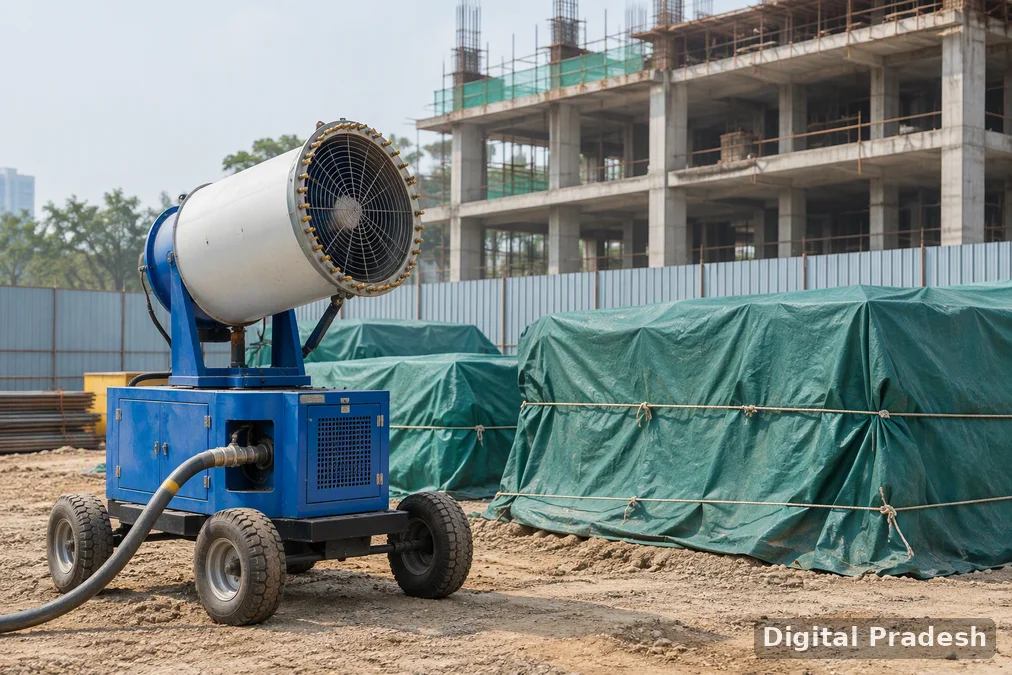
CAQM’s Stage I schedule requires enforcement of dust-control rules at construction and demolition sites. Materials and waste must be stored properly and covered, while vehicles carrying them must also be covered. The schedule calls for compliance with requirements for anti-smog guns, which spray water to suppress dust, and water sprinkling.
For projects on plots measuring 500 square metres or more, the schedule directs agencies not to permit construction and demolition activity if the project is not registered on the relevant state or Delhi government web portal, or fails other requirements for remote monitoring of dust-control measures.
This is a compliance-based restriction on those projects, rather than a blanket halt to construction under Stage I. CAQM assigns responsibility to pollution-control authorities, urban local bodies, construction agencies and plot owners, including public and private owners.
For roads, the schedule requires periodic mechanised sweeping and water sprinkling, with collected dust disposed of at designated sites or landfills. Road-owning and maintenance agencies must intensify dust suppression during construction, widening, repairs and maintenance.
CAQM also directs regular removal of municipal, construction, industrial and hazardous waste from designated dumping sites and industrial areas. Agencies must prevent illegal dumping on open land, enforce the prohibition on open burning of biomass and municipal waste, and maintain vigilance against fires at landfill and dump sites.
Bus restrictions and additional public transport
The Stage I schedule restricts inter-city and inter-state buses operating in Delhi-NCR from Haryana, Uttar Pradesh, Rajasthan, Punjab, Himachal Pradesh, Madhya Pradesh, Uttarakhand and Jammu and Kashmir. CAQM permits only electric buses, compressed natural gas (CNG) buses and diesel buses meeting Bharat Stage VI (BS-VI) emission standards within this provision.
Separately, CAQM requires strict enforcement of pollution-under-control (PUC) norms for vehicles. The schedule directs action against visibly polluting vehicles through impounding, maximum penalties, or both. Traffic police must coordinate traffic movements and deploy adequate personnel at congested corridors and intersections.
The transport provisions also require governments and operators to add CNG and electric buses and increase the frequency of Metro and Regional Rapid Transit System services. CAQM’s schedule calls for differential fares to encourage travel outside peak hours and asks governments to encourage offices to arrange shared employee commuting.
These are directions to agencies and operators. The 21 October order does not specify how many additional buses or train services will be introduced, or announce revised fares.
Generator rules depend on capacity and equipment
CAQM’s schedule directs electricity distribution companies to minimise interruptions and says diesel generator sets must not serve as a regular source of power. Their operation across industrial, commercial and residential premises remains subject to the commission’s specified emission-control requirements.
The schedule does not impose a uniform prohibition on every generator. It distinguishes equipment by fuel, capacity and emission standards. For example, generators running on listed gaseous fuels, including natural gas and biogas, have no use restrictions under its generator table.
For older diesel generators rated from 41 kilowatts to below 800 kilowatts, CAQM specifies either dual-fuel operation or retrofitted emission-control devices installed through certified agencies. Portable diesel generators below 19 kilowatts are generally not permitted, except for prescribed emergency services.
The listed emergency services include medical facilities, railway and Metro services, airports, water pumping, sewage treatment, telecommunications and information technology or data services. The schedule also includes operation of elevators, escalators and travelators.
For businesses, CAQM’s Stage I measures require intensified inspections of industries, enforcement of emission standards and use of approved fuels at industrial units, brick kilns and hot-mix plants. Hotels, restaurants and open eateries must comply with the existing ban on coal and firewood in tandoors and use electricity, gas or other clean-fuel appliances.
Complaint handling and further review
CAQM’s schedule requires agencies to issue pollution alerts and use mobile applications to inform residents about pollution levels and reporting channels. It directs prompt action on complaints received through the 311 App, Green Delhi App, SAMEER App and other platforms.
The commission’s citizen charter encourages public transport and vehicle pooling, proper waste disposal and reporting of polluting activities. It also asks residents to avoid diesel generator use except for essential activities.
In its 21 October order, CAQM said the GRAP sub-committee would keep the air quality situation under close watch and review it periodically. Further decisions, the order states, will depend on Delhi’s air quality and forecasts from the India Meteorological Department and the Indian Institute of Tropical Meteorology.

Please log in to leave a comment.