TEC: Four telecom equipment standards revised, effective 21 Oct
Four revised TEC standards took effect on 21 October 2026, covering fraud-management testing, lawful-interception monitoring equipment and optical fibre cables. The notification specifies no separate transition period.
In this article
Listen to this article
The Central Government has notified four revised telecom equipment standards, covering fraud-management testing, lawful-interception monitoring equipment and optical fibre cables, with effect from 21 October 2026. The Ministry of Communications’ notification S.O. 5722(E), dated 15 October, makes the revisions effective on publication in the Official Gazette, which carries the 21 October date.
Issued under the Department of Telecommunications’ Telecommunication Engineering Centre (TEC), the notification invokes section 19 of the Telecommunications Act, 2023, read with rule 5 of the Telecommunications (Framework to Notify Standards, Conformity Assessment and Certification) Rules, 2025. It is signed by Deputy Director General Rajeev Kumar Tyagi.
The notification identifies the revised documents by their standard numbers and titles. It does not reproduce their technical specifications or explain how individual requirements differ from the earlier versions. It also does not specify a separate transition period.
The four revised standards
The first entry is TEC 58111:2026, the Test Guide for the Fraud Management and Control Centre (FMCC). The ministry’s notification identifies this as a test guide, rather than a generic-requirements document. It does not describe the tests or set out changes to fraud-management functions.
The second is TEC 61020:2025, titled “Generic Requirements Monitoring Equipment for Lawful Interception of PSTN / NGN / IMS”. This entry concerns monitoring equipment for the network categories named in the title. The notification revises the equipment standard; it contains no direction authorising a particular interception.
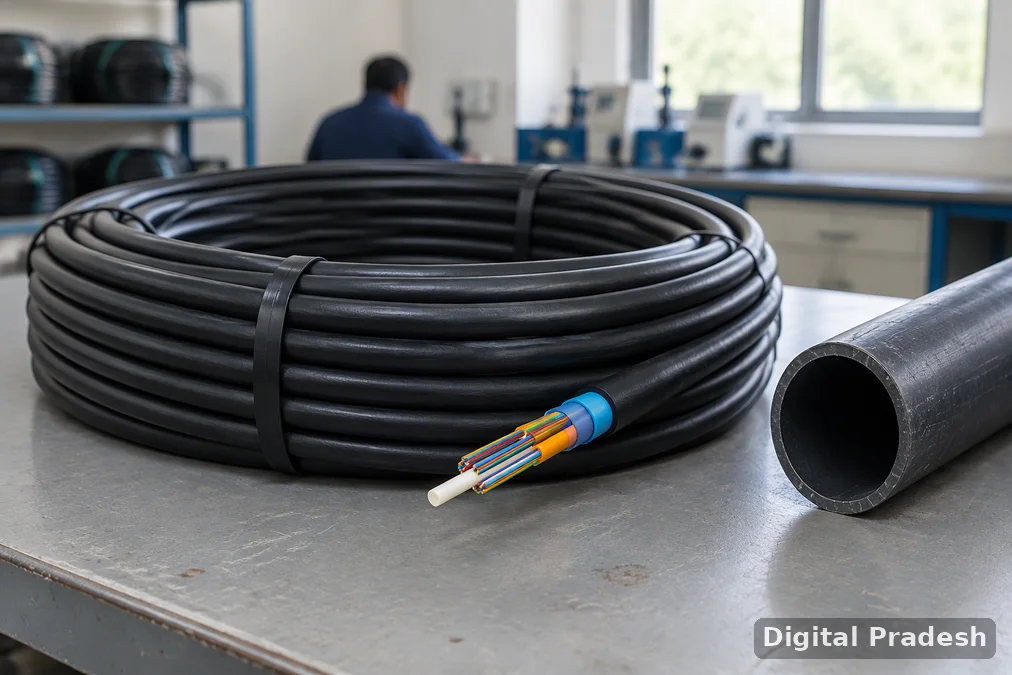
The remaining entries concern cables intended for underground ducts. TEC 85030:2026 sets out generic requirements for metal-free ribbon optical fibre cable with a nylon outer sheath, according to the notification.
TEC 85140:2026 covers generic requirements for metal-free optical fibre cable with a nylon outer sheath for underground duct use, specifying Type-I and Type-II. The Gazette lists this separately from the ribbon-cable standard.
These titles establish the equipment categories covered, but not the detailed performance requirements. The notification does not state particular cable dimensions, testing thresholds or monitoring capabilities, so it does not establish whether any such parameter has become more stringent.
Publication date and transition provisions
The distinction between the notification’s date and its publication date matters because its commencement clause expressly chooses publication as the trigger. The four revisions therefore take effect from the Gazette date, rather than from 15 October, when the notification was dated.
The ministry’s 2025 framework rules provide the mechanism for this. Rule 5 says a notified standard takes effect from the date specified in it. For a revision or amendment, the appropriate authority may also issue an order permitting the revised and existing standards to operate concurrently for a specified period.
S.O. 5722(E) contains no such concurrent-operation provision. Its publication-date clause establishes when these revisions take effect, but the document itself does not explain how existing certificates are to be treated.
The framework rules distinguish standards from conformity assessment. A standard can prescribe equipment characteristics, specifications, testing methods and procedures. Conformity assessment is the process used to demonstrate and determine whether the notified standard has been met.
Under rule 4, the TEC and the National Centre for Communication Security, both within the Department of Telecommunications, are designated as appropriate authorities for the framework.
Certification duties under the framework
The practical compliance obligations come from the 2025 rules, not from a new certification procedure set out in the October notification.
Rule 7 requires every person to whom a notified standard applies to bear the cost of complying with the relevant conformity-assessment measures. It also requires an application for a conformity-assessment certificate, as required for the relevant standard, using the form, procedure and fees specified by the appropriate authority.
Rule 8 prohibits equipment to which a standard applies from being sold, deployed in a telecom network or otherwise used in India without a valid conformity-assessment certificate. It also requires details of the standard and certificate to be displayed in the manner specified by the authority.
The framework includes exemptions. Rule 9 exempts equipment imported for research and development, demonstration, sample testing or a regulatory sandbox, subject to the relevant rules and procedures. It also exempts equipment brought into India for personal use where its import or use is not otherwise prohibited.
That rule also addresses circumstances in which recertification is not required, referring to equipment whose model or brand does not differ from that certified and compliance with notified labelling changes. The October notification does not provide equipment-specific instructions on those provisions.
Consultation and access to the technical documents
Rule 5 of the ministry’s framework generally requires draft standards and conformity-assessment measures to undergo at least 60 days of stakeholder consultation. The requirement also applies to revisions and amendments, except corrections of non-substantive typographical mistakes or apparent errors.
The rules allow provisional notification without prior consultation for specified policy reasons recorded in writing, followed by a consultation process within 60 days. They also require notified standards and conformity-assessment measures to be reviewed at least once in five years. The October notification does not describe the consultation history of these four revisions.
TEC’s office memorandum of 18 May 2026 sets out how approved standards and their Gazette notifications should be made available. Its Standardization Division is to process Gazette publication and provide the notification to the concerned division on the publication day, on a best-effort basis.
Under that memorandum, the concerned division should then forward both the verified standard and its Gazette notification to the IT Division on the same day, as far as practicable. The IT Division is directed, on a best-effort basis, to upload both documents under the TEC portal’s “Standards/Specifications” tab on the day it receives them.

Please log in to leave a comment.


