CAQM: Reviews Punjab and Haryana stubble-burning controls
CAQM urged Punjab and Haryana to strengthen stubble-burning prevention after reviewing machinery use, straw collection and monitoring. Haryana's review also covered vehicle, dust and industrial pollution.
In this article
Listen to this article
The Commission for Air Quality Management (CAQM) reviewed stubble-burning prevention and other pollution controls with the Punjab and Haryana governments at separate meetings in Chandigarh on 22 October, urging prompt local action, PTI reported in ThePrint. The commission examined machinery use, crop-residue collection and monitoring arrangements, while Haryana’s review also covered vehicles, road dust, construction and industry.
CAQM Chairperson Rajesh Verma led the review, and Haryana Chief Secretary Anurag Rastogi attended the meeting with his state’s government, according to PTI. The commission warned district administrations that negligence leading to an increase in stubble-burning incidents would be taken seriously.
The meetings followed an expansion of field monitoring earlier in the harvesting season. In its press release dated 5 October 2026, CAQM said flying squads had been deployed across 34 districts: 18 in Punjab and 16 in Haryana. The deployment was scheduled from 1 October to 30 November 2026.
Machinery use and straw collection under review
The Punjab meeting focused on implementation of the State Action Plan for preventing and controlling paddy stubble burning, following CAQM’s directions of 15 May 2026, PTI reported, citing an official statement. The commission examined district preparedness, enforcement and the availability and use of Crop Residue Management machinery at both district and farmer levels.
According to PTI, CAQM assessed gaps in machinery utilisation and arrangements to collect, transport and use paddy straw. It called for stronger links between these operations and effective use of available machines during the peak harvesting period.
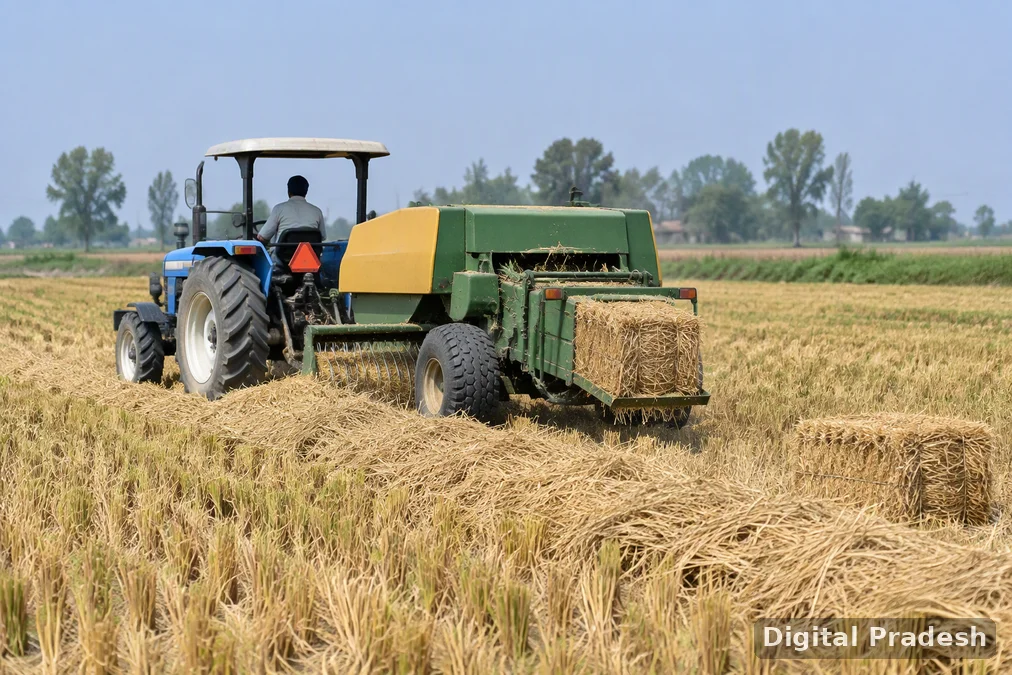
These arrangements support two different ways of handling residue. The Ministry of Agriculture and Farmers Welfare’s Operational Guidelines for Crop Residue Management, 2024, describe in-situ management as retaining, incorporating or mulching residue in the field, or helping it decompose using microbes. Ex-situ management involves removing straw from the field, including by baling and transporting it for use elsewhere.
The ministry’s guidelines make the off-field option conditional on viable uses and the necessary facilities and infrastructure. Their supply-chain strategy provides for collecting, compacting and storing straw before supplying it to industries according to demand.
The distinction explains the review’s separate attention to machinery availability and actual use. PTI reported that CAQM also examined compliance with its directive on paddy straw-based pellets and briquettes in brick kilns, and progress towards biomass co-firing targets in thermal power plants. Co-firing means using biomass alongside another fuel.
Haryana reports machinery distribution and industrial use
Haryana Director of Agriculture Amit Khatri told the meeting that the state had distributed 13,200 crop-residue management machines against a target of 9,000, according to PTI. The report described this as exceeding the target by 47 per cent.
The Haryana review covered the same operational questions as Punjab’s: enforcement, machinery deployment and utilisation, residue supply chains and checks on burnt-area assessments, PTI reported. Distribution figures were therefore one part of a wider assessment of how the equipment was being used.
According to the official statement reported by PTI, district-level agreements had been made with industries to use 27.10 lakh metric tonnes of paddy residue during the season. Those agreements concerned intended use, rather than a quantity already consumed.
Separately, the meeting was informed that biomass-based power projects had consumed 7.284 lakh metric tonnes of paddy straw by 30 September, reaching 77.16 per cent of their annual target. Compressed biogas plants had used another 1.053 lakh metric tonnes, according to the statement cited by PTI.
The statement also reported that brick kilns in eight Haryana districts outside the National Capital Region were using paddy straw pellets at an average co-firing rate of 21.9 per cent. Of the 708 kilns in those districts, 707 had achieved compliance, PTI reported.
On enforcement, PTI reported that Haryana had registered 52 first information reports, or police case records, relating to stubble burning during the year, leading to 21 arrests. These were reported enforcement actions, not convictions.
Ground checks alongside satellite alerts
CAQM examined field validation of satellite-based fire alerts and burnt-area assessments, as well as district-level use of drones and low-cost sensors, according to PTI. Haryana was using a mobile application developed by the National Remote Sensing Centre to verify burnt areas at village level.
Haryana State Pollution Control Board Chairman Shekhar Vidyarthi told the meeting that the state had installed 79 PM2.5 sensors in identified red-zone villages to strengthen monitoring of air pollution and stubble burning, PTI reported. PM2.5 refers to fine airborne particles.
The flying-squad programme provides a separate channel for ground reports. CAQM’s 5 October press release said the teams would assess conditions in their assigned districts and coordinate with farmers, the Parali Protection Force, district authorities, state nodal officers and pollution control boards.
The commission directed the squads to report daily to its cell at SAS Nagar on ground conditions and steps taken to prevent further burning. It said deployments were organised in successive phases to maintain monitoring through the harvesting season and support follow-up with the authorities concerned.
Haryana review extends to traffic and dust
Beyond agricultural burning, CAQM reviewed Haryana’s measures against pollution from vehicles, roads and open areas, construction and demolition, and industry, according to PTI.
The vehicle review included Automatic Number Plate Recognition systems at fuel and CNG stations to enforce requirements for valid Pollution Under Control Certificates, the certificates used to demonstrate compliance with vehicle-emission checks. It also covered action against end-of-life vehicles, cleaner mobility and progress towards phasing out diesel-operated auto rickshaws in National Capital Region districts, PTI reported.
Haryana had approved procurement of 600 number-plate recognition cameras for Rs 14.50 crore and issued a separate tender for another 1,500 cameras, according to PTI. These were procurement measures, distinct from cameras already installed.
The meeting was separately informed that congestion-reduction measures had been implemented at 84 locations requiring short-term interventions and 10 needing long-term solutions. A total of 205 number-plate recognition cameras had been installed at those locations for automated enforcement, PTI reported.
CAQM also advised both governments to improve implementation of their Information, Education and Communication action plans, according to PTI. These are public-awareness measures; the agriculture ministry’s 2024 guidelines describe demonstrations, capacity-building and stakeholder communication as part of efforts to improve crop-residue management. The commission called for the plans to be carried out more effectively on the ground.

Please log in to leave a comment.


