Nav-Trinjan cotton: Modi highlights Punjab weaving initiative
Modi highlighted Nav-Trinjan in Mann Ki Baat, crediting Kheti Virasat Mission with linking organic cotton farming and women's weaving training in Punjab. The address did not announce a new programme.
In this article
Listen to this article
Prime Minister Narendra Modi highlighted Punjab’s Nav-Trinjan cotton and weaving initiative in the 139th episode of Mann Ki Baat, describing how it links organic cultivation in the Malwa region with handloom training for women. In the address published by the Prime Minister’s Office, Modi credited Kheti Virasat Mission with developing the initiative to revive traditional agricultural practices and pass weaving skills to a new generation.
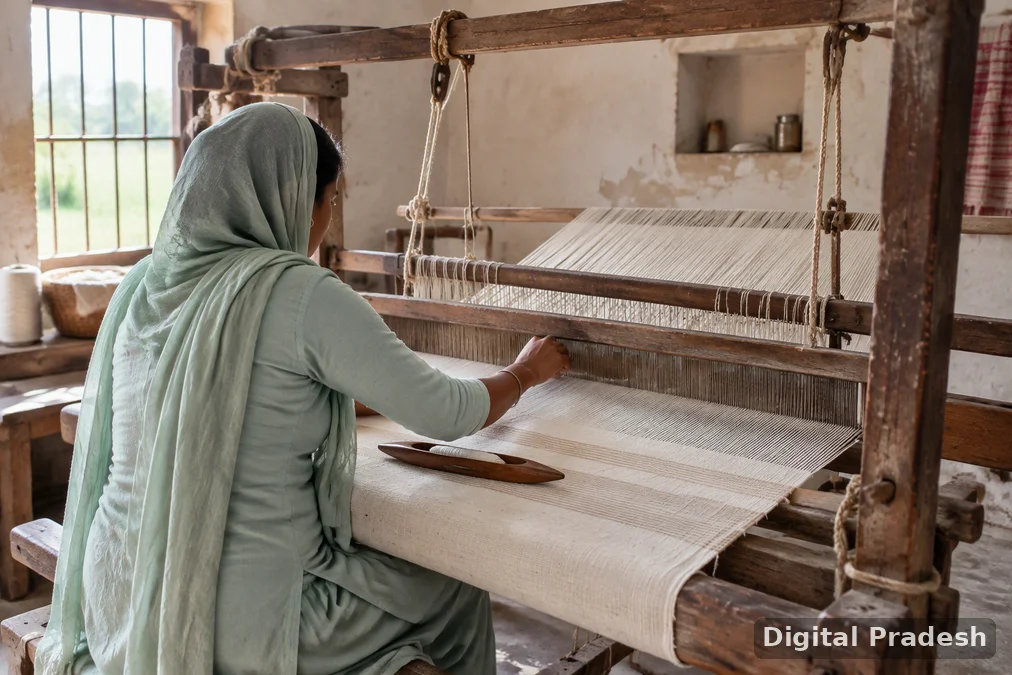
Modi said women trained through Nav-Trinjan were making shawls, towels and other textiles from indigenous organic cotton yarn. He presented the initiative as an example of traditional skills being adapted to present-day needs, citing women who had moved from agricultural labour or domestic work into weaving.
The broadcast brought attention to an existing initiative rather than announcing a new programme. Modi said Kheti Virasat Mission had been working on traditional farming for some time and that Nav-Trinjan had opened its weaving school a few years earlier. He did not give an opening date for the school.
From cotton cultivation to finished cloth
According to Modi’s account, Nav-Trinjan promotes cotton cultivation without chemical inputs in Punjab’s Malwa region. It also grows naturally coloured cotton, which he said removes the need to use separate chemical dyes to colour the yarn and fabric made from it.
Modi described this as an environmental benefit. His remarks did not include measurements of chemical use avoided or an assessment of the initiative’s environmental impact.
Kheti Virasat Mission’s own description of its Trinjan project explains how the agricultural and textile work connect. The organisation says it buys organically grown indigenous cotton from farmers at premium prices, after which rural artisans hand-spin, naturally dye and hand-weave it. The description does not specify the size of the premium paid to farmers.
Naturally coloured cotton and natural dyeing are distinct parts of these accounts. Modi referred to colour already present in the cotton, while Kheti Virasat Mission describes a process in which artisans also colour yarn using natural materials. The organisation lists marigold flowers, onion skins, pomegranate skins and tree bark among the materials used in its dyeing training.
Nav-Trinjan’s website describes its purpose as connecting farming with handmade textile production. It identifies rebuilding local links between farmers, spinners and weavers as an objective, alongside preserving indigenous cotton varieties and providing work for rural women within their villages.
This approach extends beyond teaching people to operate a loom. Kheti Virasat Mission says its training covers yarn and fabric quality, design, productivity and marketing. It also says it markets artisans’ products on public platforms and organises exhibitions, demonstrations and cultural gatherings.
Women learning a new occupation
Modi used four participants’ experiences to illustrate the weaving school’s work. These were accounts given by the Prime Minister, rather than income findings from a programme evaluation.
Ramandeep Kaur had previously worked as a labourer and became a skilled weaver after training at the school, Modi said. Rekha Rani, he said, had never seen a handloom before her training; a shawl she subsequently made was presented to the President of India.
He also mentioned Suneha Devi, who had earlier worked in people’s homes and now makes fabric on a handloom. Rajini Kaur had depended on agricultural labour, Modi said, and her newly acquired weaving skills were helping her support her household.
The address described improved livelihoods but did not state the women’s earnings, the number of people trained or the proportion who had secured regular paid work. It therefore offered individual examples of occupational change without establishing the scale of the programme’s income effects.
Nav-Trinjan’s own account says training women who are the first in their families to weave is one of its priorities. It describes locally rooted work as a way for participants to earn while remaining in their villages and to pass traditional knowledge to new practitioners.
The Tribune, in its report on a Nav-Trinjan exhibition in Jaito, also described the initiative’s Bunkar Pathshala, or weaving school. It named master artisans Shinder Kaur and Gurmeet Kaur as trainers teaching young people from weaving families, and reported that several trainees had become skilled weavers earning livelihoods.
Reviving the Trinjan gathering
The initiative takes its name from Punjab’s traditional Trinjan gatherings. Kheti Virasat Mission describes these as spaces where women spun on charkhas, or spinning wheels, wove, exchanged knowledge and spent time together. Nav-Trinjan’s website similarly identifies these gatherings as the inspiration for its work.
Kheti Virasat Mission says its Trinjan project began in four villages in 2017. That account concerns the wider traditional-skills project; it does not establish when the weaving school mentioned in Modi’s address opened.
The Tribune’s exhibition report described products ranging from handspun yarn and handwoven khadi to dupattas, stoles and naturally dyed textiles. It presented the initiative as an effort to reconnect the stages of textile production, recognising the contributions of farmers, spinners, dyers and weavers rather than focusing only on finished fabric.
Modi said his familiarity with the team preceded the broadcast. Recalling a meeting on National Handloom Day a few months earlier, he said he had seen the participants’ commitment to their work.

Please log in to leave a comment.


