Mathura bridges: Special Railway Project status notified
Two proposed two-lane bridges in Mathura have received Special Railway Project status for land acquisition. The notification does not identify plots, set compensation or announce a construction timetable.
In this article
Listen to this article
The Centre has designated two road-over-bridge works in Uttar Pradesh’s Mathura district as a Special Railway Project for land acquisition, according to the Ministry of Railways’ notification published on 26 October 2026. The works cover two-lane bridges in place of level crossings in the Agra Division of North Central Railway.
Notification S.O. 5789(E), issued from Prayagraj under North Central Railway’s Gati Shakti Unit, identifies the purpose as providing national infrastructure for public use. It makes the designation effective from its publication in the official Gazette, rather than setting a future commencement date.
The notification establishes the project’s status for land acquisition. It does not identify individual plots to be acquired, specify compensation amounts or announce a construction timetable.
The two crossing locations
The Ministry of Railways identifies the first work as a road-over-bridge replacing level crossing No. 373 at Km 372/6-7 on the MTJ-AH section. The second replaces level crossing No. 547 at Km 1435/20-22 on the MTJ-PWL section. Both locations are covered by the same Special Railway Project designation.
These kilometre references identify the railway locations; they are not measurements of the proposed bridges. The notification specifies two-lane construction but gives no bridge length, approach-road dimensions or detailed alignment.
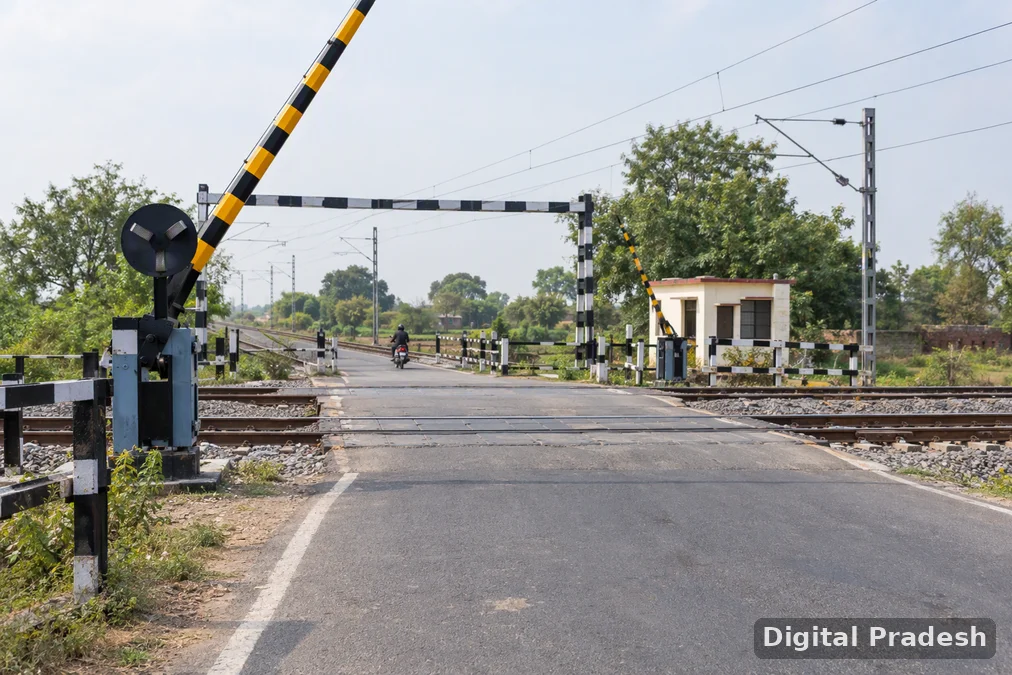
A level crossing is where a road and railway track meet at the same level, according to the training presentation Level Crossing, hosted by the Indian Railways Institute of Transport Management. A road-over-bridge instead carries the road above the railway, separating the two routes vertically.
The institute’s presentation explains that level-crossing gates are movable barriers used to close the road, and that arrangements for opening and closing them depend on road and rail operations. That provides the operational context for replacing a crossing with a bridge. The Mathura notification, however, contains no traffic counts, gate-closure records or estimate of journey-time savings at either location.
What the land-acquisition designation covers
The notification cites clause (37A) of Section 2 of the Railways (Amendment) Act, 2008 as the authority for the designation. It is signed by Anamul Haque, identified in the document as Chief Administrative Officer /C.
The Railways Act, 1989, in the text hosted by the Railway Protection Force, contains a dedicated Chapter IVA titled “Land Acquisition for a Special Railway Project”. Its listed provisions distinguish the power to acquire land from surveys, objections, the declaration of acquisition, compensation and possession.
Those distinctions matter when interpreting the Mathura announcement. A designation of the railway project does not, in its wording, provide a plot-by-plot acquisition declaration or a compensation award.
The Act’s arrangement of sections identifies Section 20D with the hearing of objections and Section 20E with the declaration of acquisition. It separately identifies Section 20F with determining compensation and Section 20G with the criteria for determining land’s market value. Deposit and payment of the amount fall under Section 20H, while Section 20-I concerns possession.
These are separate subjects within the statutory framework, not findings that those stages have been completed for the Mathura bridges. The October notification does not report their completion or name the landowners affected.
The Railway Board’s earlier instructions
The administrative background includes a Railway Board letter dated 19 December 2014 on notifying Special Railway Projects for land acquisition. The Board said the Ministry of Railways had authorised specified construction officials to issue Gazette notifications with the approval of the zonal railway’s general manager.
The letter described the measure as a way to expedite notification of projects appearing in the railway’s Pink Book or funded by the Railways. It concerned authority to issue the designation, rather than a timetable for completing a particular bridge.
In a subsequent letter dated 21 August 2019, the Railway Board asked zonal railways to adhere strictly to its land-acquisition instructions and rules. The Board said at that time that large sums deposited by the Railways for acquisition remained pending with state governments. That was a historical, railway-wide observation, not a statement about funding for these Mathura works.
Compensation administration and the details still absent
The Land Acquisition (Special Railway Projects) Rules, 2016, reproduced with the Railway Board correspondence, describe how acquisition money is to be handled. They provide for the Central Government to deposit the specified amounts with the competent authority, the authority responsible for administering the relevant acquisition functions.
Under those rules, the authority places the money in an account at a nationalised bank. The account is controlled by the competent authority and operated jointly with an accounts officer nominated by the Central Government. The rules also provide for appointing an arbitrator for the purposes of Section 20F(6).
These provisions explain the documented administrative framework; they do not establish an entitlement or payment amount for any particular Mathura property. The Ministry of Railways’ notification supplies neither a land-area total nor a village or plot schedule. It also leaves the project’s cost, construction start date and opening date unspecified.

Please log in to leave a comment.


