Texworth: Workers record tasks for training robots, NPR says
Texworth workers in Karur wear cameras to help train robots, NPR reports. Accounts differ on payment and disclosure, and the reporting does not establish that robots have replaced those interviewed.
In this article
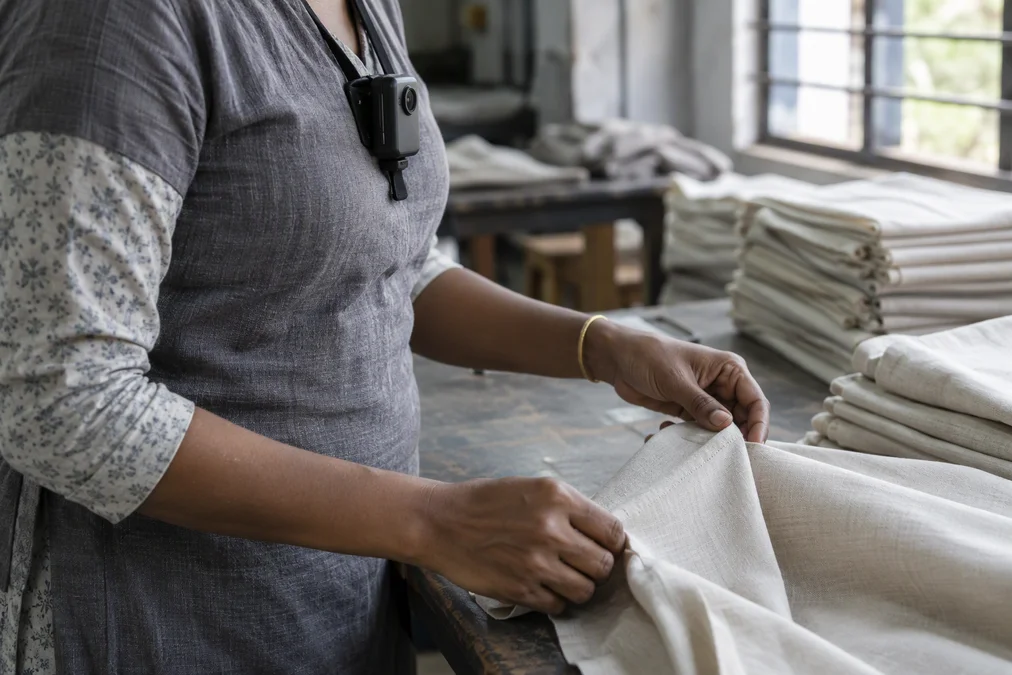
Workers at Texworth’s textile factory in Karur, India, are wearing cameras to record their hand movements for training robots, according to an NPR report published on 14 October 2026. Some receive additional payment and know the purpose. Others told NPR they had not been informed that their work was being recorded to help machines learn those tasks.
Shoba Kirubakaran, who was packing aprons for the brand Designs By Danica, told NPR it was the third time she had been instructed to wear a GoPro camera. She said the company had not explained the robot-training purpose before NPR told her about it.
“Nobody told me anything about it,” she told NPR.
The report documents a business built around recording human skill, from folding textiles to opening bottles and preparing food. It also reveals differences in what participating workers are told and paid. It does not establish that robots have replaced the factory workers interviewed.
At Texworth, different accounts of payment and disclosure
Kirubakaran told NPR she had worked at the factory for 10 years and earned USD 90 a month. Her account raises a question separate from whether a robot can eventually perform her job: whether workers understand the purpose of recording their movements.
Another textile worker, Kannagi Periyasaamy, described a different arrangement. NPR reported that she received about USD 2.60 an hour for recording herself and had been told why the footage was being collected.
Periyasaamy said she was demonstrating how to fold and package aprons and check their quality. She told NPR she had been recording for three months and believed a robot would eventually take over her job.
These accounts should not be treated as evidence of a uniform arrangement across the factory. NPR described Periyasaamy as one of the few workers receiving payment for recording. The supplied report does not set out the factory’s written policy, workers’ agreements or a response from Texworth addressing Kirubakaran’s account.
Astha Kapoor, co-founder of the Aapti Institute, which studies technology’s effects on people, criticised recording workers without an explanation. She described the practice to NPR as “exploitation of labor”. That is her assessment, not a finding by a court or labour authority.
What a camera can teach a robot
The footage belongs to a category called egocentric data: recordings made from the person’s own viewpoint. A head-mounted camera can capture how hands approach an object, grasp it and complete a sequence of movements.
Prathosh A.P., a professor at the Indian Institute of Science in Bengaluru, told NPR that developing robots requires teaching AI the motor skills involved in physical work. Understanding an instruction and moving a body to carry it out are different problems.
Imitation learning is the process of teaching a system through demonstrations. For a robot, those demonstrations can help connect what it sees with the actions needed to complete a task. But human hands and robotic grippers have different shapes, movements and physical limits.
The MimicPlay research project describes an approach that combines human videos with demonstrations performed through teleoperation, where a person controls a robot. Its system uses videos of people interacting with objects to learn plans, then uses robot demonstrations to learn the movements needed to execute them.
That research illustrates why footage of a worker is useful without proving that a camera recording alone can produce a job-ready robot. It also does not validate the particular systems being trained with the Karur recordings.
A commercial guide from robotics data provider EXYLOS makes a related distinction: human video, recordings made with handheld grippers and demonstrations on actual robots contain different information. The guide says usable datasets need more than footage, including descriptions of tasks, clear recording boundaries and checks on whether demonstrations succeeded.
Objectways collects demonstrations for overseas clients
NPR also visited Objectways, a technology company in Karur that collects human-task recordings for AI developers. Employee Rajeshkumar Ramaswamy showed reporters people using gripper-like devices to remove and replace bottle lids.
Ramaswamy told NPR that the process would be repeated about 100 times. The collection included bottles of different sizes and materials, giving developers examples beyond a single object.
This distinction matters in physical work. Completing a movement with one bottle does not establish that the same movement will work with a wider bottle, a different lid or another material.
Objectways also records household tasks, including folding towels, putting away books and unpacking bags. NPR described a recording space arranged like a home, where people demonstrated domestic work.
Ramaswamy said most clients seeking first-person recordings of household chores were in the United States. The company also paid Americans to record tasks so that training material reflected objects and practices found there.
He used plates to explain the issue: a grip suitable for a stainless steel plate may be unsuitable for a ceramic one. The example concerns more than recognising an object. A robot also needs to handle it without applying inappropriate force.
NPR interviewed Sneha Jegadish, who recorded household chores with a smartphone attached to a headset. She said she earned about USD 2.60 an hour and around USD 120 a month from the work. Her account shows that the collection business includes paid contributors outside factories, not only recordings added to existing production jobs.
Training demand does not establish a replacement timetable
Objectways chief executive Ravi Shankar told NPR he did not expect AI robots to be cheaper than human labour in India. He said his Indian clients sought help with jobs where recruitment was difficult, locations were isolated or tasks were physically demanding.
His examples included tapping rubber trees, cleaning solar panels in rural areas and removing stems from chillies for processing. These are his account of client demand, not evidence that robots have already been deployed successfully for every task.
Kapoor also pointed to the cost of running robots, including electricity, as a constraint on widespread adoption. NPR reported generators operating at Objectways’ premises to maintain power.
The distinction is between collecting training material now and installing reliable, affordable machines at workplaces. The former does not provide a timetable for the latter.
Amit Basole, an economics professor at Azim Premji University, told NPR that preparing workers for other occupations would require training, retraining and the capacity to absorb them into new work. He questioned whether policy could respond with sufficient agility.
What the available reporting leaves unresolved
The factory accounts in this article come from NPR’s reporting. Its republication by Tri States Public Radio is the same story, not independent corroboration. Live research was not possible; this article is based on the supplied source material.
NPR’s report does not give the exact date of the factory visit. Nor does the supplied material establish who ultimately buys the Texworth recordings, how long they are retained, whether workers can decline recording without consequences or what rights they have over later uses.
The immediate unresolved issue is therefore not only whether robots will learn to fold aprons. It is what workers have agreed to provide, what they receive in return and whether they can refuse.