CAQM: NCR outdoor construction curbs set for 5-20 November
CAQM's 5-20 November 2026 order restricts dust-generating outdoor construction across NCR. State government and private office attendance is capped at 50% in Delhi and five districts, with specified exceptions.
In this article
Listen to this article
The Commission for Air Quality Management (CAQM) has ordered restrictions on dust-generating demolition and outdoor construction across the National Capital Region (NCR) from 5 to 20 November 2026. Its order dated 30 October also limits physical attendance at state government and private offices to up to 50 per cent in Delhi and five adjoining districts, with the remaining staff working from home, subject to specified exceptions.
The office rule covers Gurugram, Faridabad, Sonipat, Ghaziabad and Gautam Buddha Nagar, alongside the National Capital Territory of Delhi. The construction restriction has a wider reach, extending across the entire NCR rather than only the areas named for office attendance.
CAQM describes the measures as preventive interventions ahead of and during a period when historical records show recurring pollution peaks. The order sets a fixed implementation period; it does not make these two directions conditional on a fresh deterioration in the daily Air Quality Index (AQI), the measure used to describe air quality.
Office attendance capped, with feasibility exceptions
Under the order, state government and private offices in the specified locations must operate with no more than half their staff attending physically. The remaining employees are to work from home.
The wording is an attendance ceiling, not a requirement that exactly 50 per cent of employees report to the workplace. It also provides for continued work remotely, rather than directing offices to close during the restriction period.
CAQM exempts industrial establishments and essential services where this arrangement is not feasible. That qualification matters: the exception is linked to whether the work-from-home arrangement can be implemented, rather than being an unrestricted exemption for every workplace describing itself as an essential service or industrial establishment.
The office provision names state government and private offices. It does not expressly include central government offices in that clause. Nor does the three-page order set out how employers should select staff for physical attendance, organise rotations or document the use of an exception.
Construction restriction includes roads and utility works
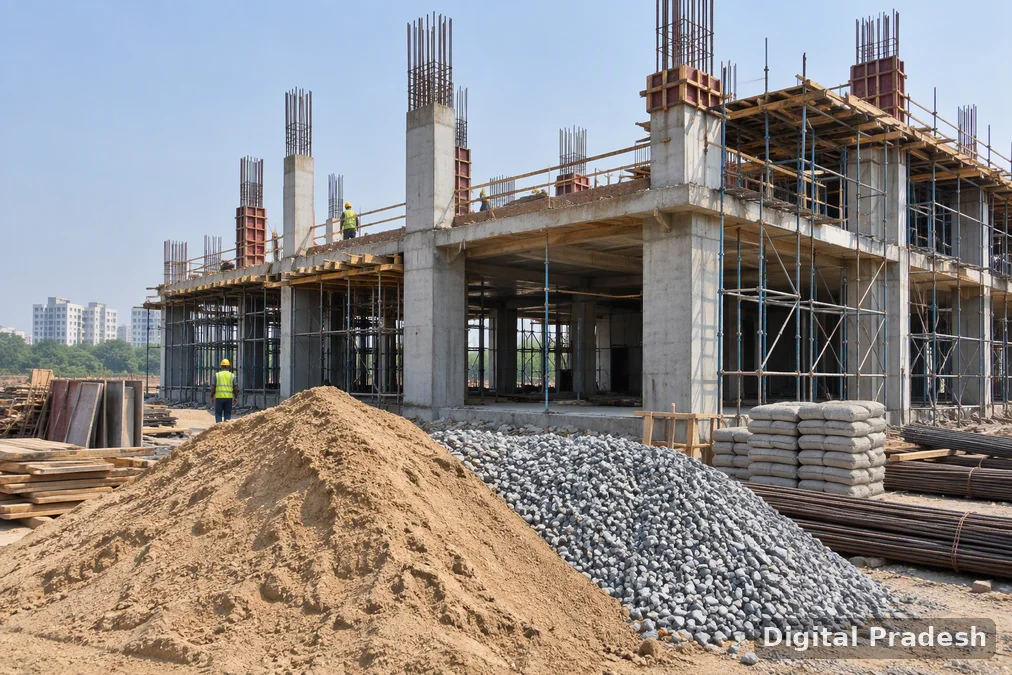
CAQM’s construction direction covers dust-generating demolition and outdoor construction activities. It expressly extends the restriction to linear public projects, meaning infrastructure running along a route, such as roads, transmission lines and pipelines.
The order lists highways, roads, flyovers, overbridges, power transmission, pipelines and telecommunication works among the projects covered. Public infrastructure is therefore not exempt simply because it serves a public purpose.
However, CAQM allows exceptions for projects related to Railways, Metro services, airports, inter-state bus terminals, hospitals, water supply and sanitation. National security and defence-related activities, along with projects of national importance, are also exempt.
These exceptions mean the direction is not a blanket shutdown of every construction project in the NCR. Its application depends on the activity and the project category specified in the order.
The Commission said the exemptions were intended to prevent disruption to essential and unavoidable activities. It described the overall restrictions as limited in duration and geographical scope, reflecting the region’s seasonal vulnerability to air pollution.
Historical November pollution informs the timing
CAQM said it examined historical daily AQI data for November from 2018 to 2025. According to the order, the record showed recurring elevated pollution during early and mid-November, with air quality reaching the “Severe” and “Severe+” categories on certain days.
That is the Commission’s account of the historical pattern, not a statement that Delhi-NCR is currently experiencing those categories. The order does not provide a current AQI reading or a day-by-day forecast for the restriction period.
The Commission identified local emissions, seasonal agricultural residue burning, biomass burning and emissions associated with episodic events as contributors to the pollution load. It also pointed to weather conditions that limit the dispersal of those pollutants.
Low wind speeds, a shallow atmospheric boundary layer and reduced vertical mixing can leave pollutants with less scope to spread out, the order explains. In plain terms, emissions accumulate when air movement provides less dilution.
CAQM said its objective was to reduce emissions at source and minimise pollutant accumulation before and during historically observed peak pollution episodes. The order does not quantify the reduction in emissions or AQI that it expects these measures to achieve.
A fixed-period direction alongside GRAP
The Commission issued the directions under Section 12 of the Commission for Air Quality Management in National Capital Region and Adjoining Areas Act, 2021. As described in the order, that provision empowers CAQM to take measures and issue directions to protect and improve air quality in the region.
The document also refers to the revised Graded Response Action Plan (GRAP) schedule dated 29 September 2026. GRAP is the framework for preventive, restrictive and other measures applied at different air-quality levels to prevent further deterioration.
The October order does not announce activation of a particular GRAP stage. Instead, it specifies the November dates for the construction and office measures on the basis of the recurring seasonal pattern.
Signed by CAQM Member Secretary Tarun Kumar Pithode, the order directs the concerned departments and agencies of NCR state governments and the Delhi government to implement the measures. It was addressed to the chief secretaries of Uttar Pradesh, Rajasthan, Haryana and Delhi, with copies to the relevant environment departments and pollution-control bodies.
The order specifies 20 November 2026 as the final day of these measures. It contains no provision automatically extending this particular set of restrictions beyond that date.

Please log in to leave a comment.


