Manastu Space: TDB signs Rs 116 crore green propulsion deal
TDB has agreed to provide Rs 116 crore through the RDI Fund for Manastu Space to develop, integrate and validate green propulsion systems for satellites and launch vehicles.
In this article
Listen to this article
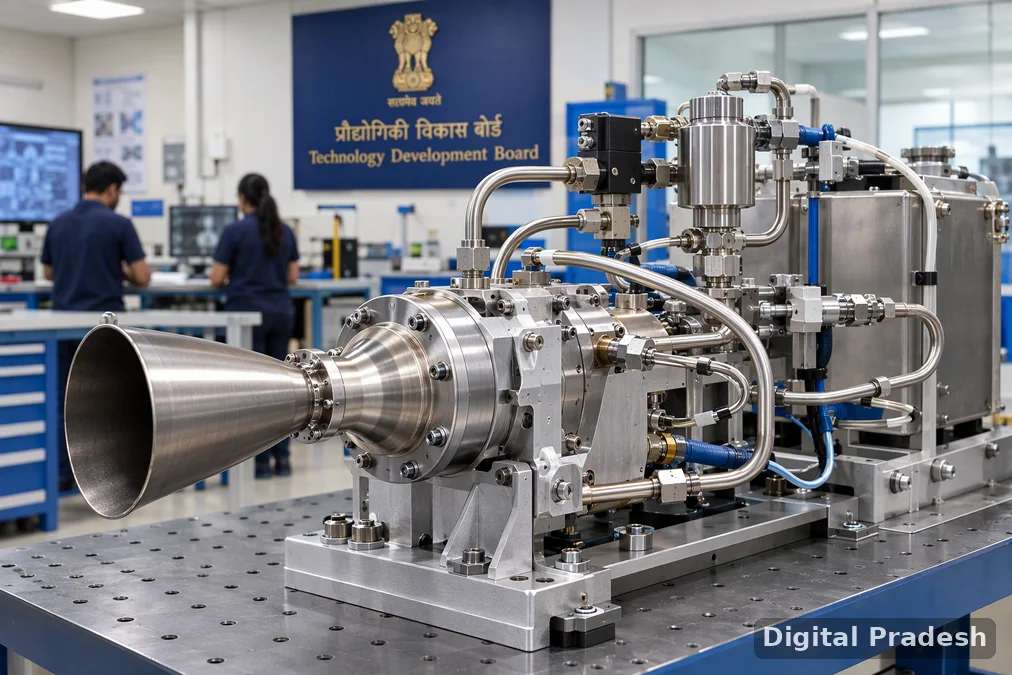
The Technology Development Board (TDB) has signed an agreement to provide Rs 116 crore to Navi Mumbai-based Manastu Space Technologies Private Limited for green propulsion systems for satellites and launch vehicles, DD News reported on 26 October 2026. The assistance will come through the Research, Development and Innovation (RDI) Fund and support a project with an estimated total cost of Rs 277.63 crore.
The funding is intended to move the technology from further development and testing towards deployment, according to DD News. The proposed integrated propulsion system will cover a thrust range of 5 millinewtons to 300 newtons, spanning small-satellite applications and higher-thrust requirements for launch vehicles. Thrust is the force a propulsion system produces to move a spacecraft.
DD News reported that the Ministry of Science and Technology identified the financing instrument as Optionally Convertible Debt. This is debt that can, under agreed conditions, be converted into an ownership stake, rather than an outright grant.
Funding development beyond an orbital experiment
The project aims to progress from Technology Readiness Level (TRL) 6 to TRL 9, DD News reported. TRL describes how far a technology has advanced towards operational use; the funded work includes engineering, system integration, testing and validation.
That distinction matters because Manastu’s propulsion technology has already undergone an orbital experiment, but the new programme covers a broader range of propulsion requirements. The Indian Space Research Organisation’s (ISRO) description of its POEM-4 mission identified a hydrogen peroxide-based, 1.1-newton green propulsion thruster from Manastu among the payloads.
POEM, the PSLV Orbital Experiment Module, uses a spent rocket stage as a platform for experiments in space. ISRO describes it as a way to test concepts and enabling technologies after the rocket has placed its primary spacecraft into orbit.
According to ISRO’s account, the PSLV-C60 mission launched on 30 December 2024, and POEM-4 began operating after the successful injection of the SpaDeX spacecraft. In its subsequent update on the platform completing 1,000 orbits on 4 March 2025, ISRO said all its payloads had successfully completed their intended orbital experiments.
Those ISRO documents establish an earlier flight experiment involving Manastu’s thruster. They do not establish that the entire propulsion range covered by the new funding agreement has completed qualification. DD News described the next phase as work to improve reliability and prepare the technology for wider deployment.
Propellant, engine and catalyst developed together
Manastu is developing a hydrogen peroxide-based propellant with additives, supported by an integrated engine and catalyst system, according to DD News. The funded project includes propulsion engines, systems that feed propellant into them, and an ultra-high-temperature ceramic catalyst intended to function under demanding operating conditions.
On its own website, Manastu describes its proprietary MS-289 propellant as a hydrogen peroxide-alcohol mixture with specialised additives. The company says its ceramic catalyst decomposes the hydrogen peroxide and ignites the alcohol fuel. A catalyst helps a chemical reaction take place.
Manastu presents the technology as an alternative to conventional hydrazine-based satellite fuels. Improvements in safety, performance and cost efficiency are objectives described in the DD News report, rather than quantified results established by the funding announcement.
The company’s product descriptions show the different spacecraft applications it is pursuing. Manastu describes Vyom 2U as a propulsion system for satellites weighing up to 100 kilograms, and I-Booster as a system for satellites weighing between 100 kilograms and 500 kilograms. Its GP-LAM product is described as a 300-newton thruster intended for applications including launch-vehicle upper stages.
These are company descriptions of its products and intended uses, not evidence that the new funding programme has already delivered its full planned capability.
RDI support targets private-sector research
TDB operates under the Department of Science and Technology. Its institutional account says the government constituted it in September 1996 under the Technology Development Board Act, 1995, to promote the development and commercialisation of indigenous technology and the adaptation of imported technology for wider use.
The board’s RDI scheme page says the Union Cabinet approved the scheme on 1 July 2025, with an outlay of Rs 1 lakh crore over six years, including Rs 20,000 crore for the financial year 2025-26. Those figures describe the scheme’s approved outlay, not expenditure on Manastu or amounts already disbursed.
According to TDB, the scheme seeks to encourage private-sector investment in research and development. Space is among its identified deep-technology fields, alongside areas such as quantum computing and robotics. The scheme supports eligible entities, including start-ups, scaling up research from TRL 4 onwards.
TDB says debt is its generally preferred funding instrument for companies and start-ups under this framework. Its scheme description also provides for financing structures involving conversion of debt into equity. The DD News report does not specify Manastu’s repayment schedule, conversion conditions or disbursement timetable.
Deployment is the stated objective
TDB Secretary Rajesh Kumar Pathak linked the agreement to the investment required between advanced development and deployment. DD News quoted him as saying: “Through the RDI Fund, TDB is supporting technology-intensive programmes that require sustained investment to progress from advanced development towards deployment.”
The report also quoted Manastu’s co-founder and chief technology officer as saying the support would help advance development, integration and validation, with TRL 9 as the objective.
DD News described stronger domestic manufacturing capabilities and reduced dependence on imported propulsion technology as aims of the project. The engineering work specified in the report remains concrete: integrate the propulsion system, test and validate it, and improve reliability before wider satellite and launch-vehicle deployment.

Please log in to leave a comment.


