Narendra Modi: Gujarat project rollout tops Rs 14,000 crore
Modi inaugurated facilities and laid foundation stones for Gujarat projects worth over Rs 14,000 crore. He separately released more than Rs 18,000 crore to farmers nationwide under PM-KISAN.
In this article
Listen to this article
Prime Minister Narendra Modi inaugurated, dedicated to the nation and laid foundation stones for projects worth more than Rs 14,000 crore in Banaskantha, Gujarat, on 30 October 2026, DD News reported. The programme covered agriculture, dairy, livestock development, transport links and facilities for women and children, combining completed facilities with projects at the foundation-stone stage.
Modi also released more than Rs 18,000 crore to about 10 crore farmers nationwide under PM-KISAN, according to the account published on the Prime Minister’s website. This farmer-income transfer was announced alongside the infrastructure programme, rather than as a component of the Rs 14,000 crore project total.
The event followed the previously announced Gujarat visit. Its agricultural components included a livestock breeding centre, expanded potato-processing capacity and foundation stones for two plants intended to turn cattle dung into fuel and fertiliser, the Prime Minister’s website said.
Breeding centre targets indigenous cattle and buffaloes
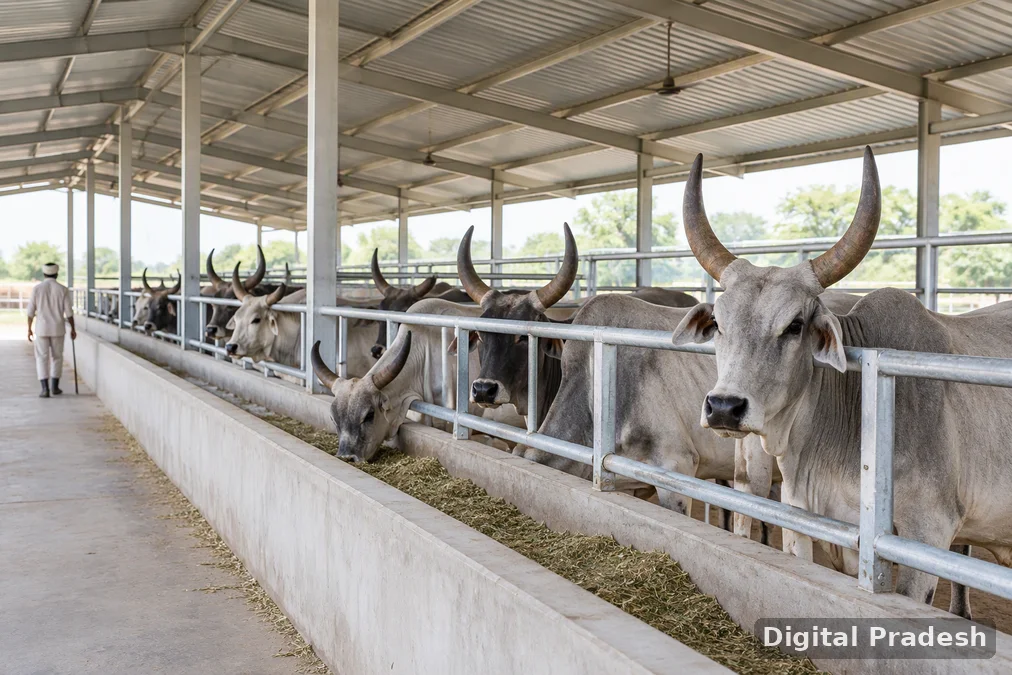
The Bharat Bovine Breeding and Research Centre at Bhildi was the largest of three Banas Dairy projects detailed ahead of the event. ANI reported on 29 October, citing a Gujarat Chief Minister’s Office release, that the three facilities had a combined cost of Rs 407.56 crore.
That total comprised Rs 324.77 crore for the breeding centre, Rs 51.65 crore for the French fries processing project at Sanadar and Rs 31.14 crore for an automated dairy storage facility at Palanpur, according to the release reported by ANI.
The Chief Minister’s Office said the breeding centre occupied 127 acres and received technical support from the National Dairy Development Board, ANI reported. It said Rs 38.83 crore had been sanctioned under the Rashtriya Gokul Mission, including Rs 2 crore for donor animals.
In his address, Modi said the newly built centre would support the conservation and improvement of Gir, Sahiwal and Kankrej cattle, as well as Mehsana, Murrah and Jaffarabadi buffaloes, according to the Prime Minister’s website. He described it as the country’s first such facility for the Kankrej breed.
The Rashtriya Gokul Mission supports the conservation and scientific breeding of indigenous livestock, the website’s account explained. Modi linked the centre’s work to the use of reproductive technology, including in vitro fertilisation, or IVF, to help pass desirable traits to future generations of animals.
He presented better breeding, vaccination and veterinary treatment as complementary ways to improve milk production and reduce disease-related losses. Those were the benefits outlined in his address, rather than measured results from the new centre.
Potato processing, storage and dung-based fuel
The Sanadar project expanded French fries production capacity from 2 tonnes to 5 tonnes per hour, according to the Gujarat Chief Minister’s Office release reported by ANI. Work on the expansion began in April 2026.
The release described Banas Dairy’s production chain as extending from plantlets developed in test tubes and seed-crop cultivation to potato cold storage and finished French fries. In his subsequent address, Modi said the increased processing capacity would enable greater potato procurement, according to the Prime Minister’s website.
The Palanpur facility addresses a different part of dairy operations: storing and dispatching ultra-high-temperature, or UHT, milk products. ANI reported that its Automated Storage and Retrieval System used steel racks across nine levels, with capacity for 11,000 pallets.
According to the Chief Minister’s Office release carried by ANI, the system was developed in-house by Banas Dairy and designed for high-speed, automated and traceable warehouse handling. The release scheduled its virtual inauguration, along with the processing plant, for 30 October.
The Prime Minister’s website confirmed that foundation stones were laid for two bio-CNG plants. Bio-CNG is a compressed gas fuel produced from biological material; the account described the use of cattle dung and agricultural residue to produce fuel and organic fertiliser.
ANI’s advance report identified the locations as Tharad and Radhanpur and said Banas Dairy already operated four dung-processing plants. The new facilities remained foundation-stone projects, distinct from the newly built breeding centre.
Rail services, metro extensions and wider roads
The connectivity programme included the flagging off of the Ahmedabad (Sabarmati)-Varanasi Express and the Mehsana-Becharaji-Sabarmati MEMU service, DD News reported. MEMU trains are electric multiple-unit trains used for mainline passenger services.
Modi also laid foundation stones for Ahmedabad Metro extensions connecting the airport and GIFT City, according to DD News. These announcements concerned future extensions, not the opening of those metro connections.
The Prime Minister’s website separately recorded his announcement that the Ahmedabad-Mehsana highway would be widened from four lanes to eight lanes. The programme therefore brought together rail services being launched and road and metro works still to be developed.
For women and children, Modi said more than 4,000 modern Anganwadi centres had been inaugurated across Gujarat, according to his website. He put their expected reach at about 4 lakh children and pregnant women. Anganwadis provide community-level services for young children and mothers.
Farmer payments and horticulture clusters
Within the nationwide PM-KISAN release, more than Rs 1,000 crore went to over 50 lakh farmers in Gujarat, including nearly Rs 50 crore for farming families in Banaskantha, Modi said, according to the Prime Minister’s website.
PM-KISAN transfers money directly into farmers’ bank accounts. Modi said cumulative transfers to small farmers under the scheme had reached nearly Rs 4.5 lakh crore; that was his nationwide figure, not an allocation for the Banaskantha projects.
The address also covered approval of 12 horticulture clusters for crops including tomatoes, potatoes, chillies, grapes, bananas, onions, oranges, pomegranates and cocoa. According to the Prime Minister’s website, Modi said the programme included subsidies for planting new orchards and rejuvenating existing ones.
Two of the approved clusters were in North Gujarat. Modi said these would benefit potato growers in Banaskantha and Sabarkantha, linking the cultivation programme with the expansion of potato-processing capacity described during the visit.

Please log in to leave a comment.


