Container scheme: Union Cabinet approves Rs 10,000 crore
The approved container manufacturing scheme runs through FY2039-40, with support for production, borrowing costs and testing, alongside rising local-content requirements.
In this article
Listen to this article
The Union Cabinet has approved the Container Manufacturing Promotion Scheme (CMPS) with an outlay of Rs 10,000 crore up to financial year 2039-40, according to the Cabinet announcement published by the Prime Minister’s Office. The scheme supports new factories and expansion of existing units, with assistance for borrowing costs, container production, and testing and certification.
The Press Information Bureau’s (PIB) explanatory note dated 28 October 2026 sets out capacity thresholds, per-container payments and local-content requirements. The government aims to increase annual domestic manufacturing capacity around ten-fold to 7.5 lakh twenty-foot equivalent units (TEUs), while reducing dependence on imported containers.
The approved funding horizon differs from the original Budget proposal. Finance Minister Nirmala Sitharaman’s Budget speech on 1 February 2026 proposed Rs 10,000 crore over five years. The Cabinet announcement retains that amount but specifies support up to financial year 2039-40.
Production and sales receive the largest allocation
The Cabinet announcement divides the outlay into Rs 8,891 crore for Operational Expenditure Assistance, Rs 859 crore for Interest Subvention Assistance and Rs 150 crore for testing and certification facilities.
Operational expenditure assistance supports containers that eligible manufacturers produce to global shipping standards and sell. The Cabinet said this component is intended to bridge the cost gap and improve the competitiveness of Indian-made containers. It is therefore linked to compliant production and sales, rather than simply the establishment of a factory.
According to PIB’s 28 October note, assistance is Rs 49,500 for each 20-foot container and Rs 86,625 for each 40-foot container. For 20-foot specialised containers, the stated range is Rs 37,125 to Rs 74,250 per container. The note does not explain which specialised container categories receive each rate within that range.
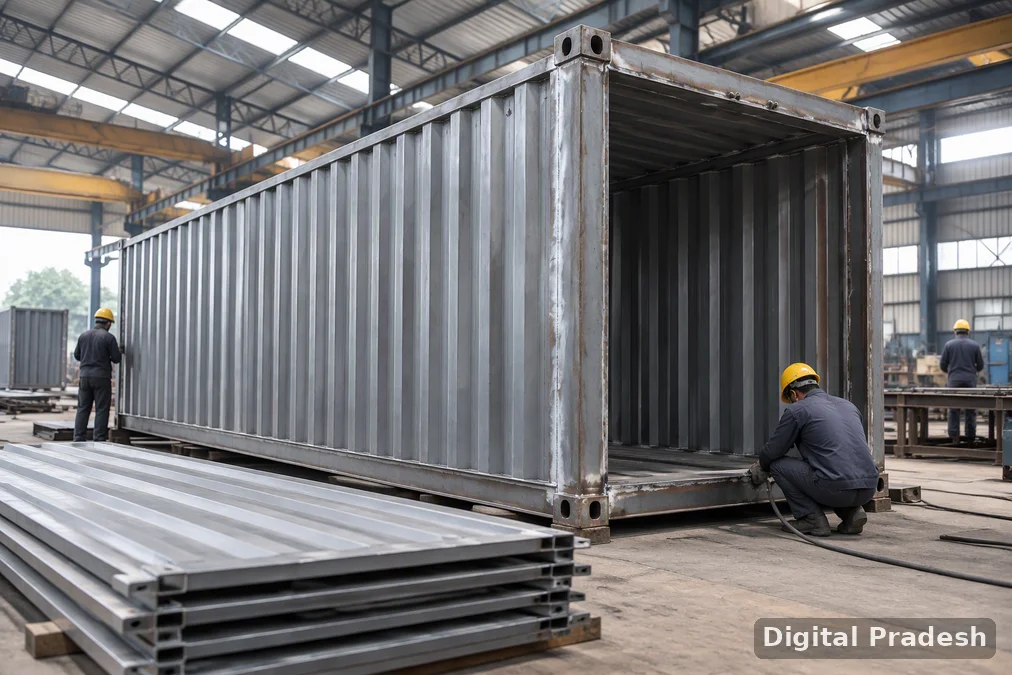
PIB describes shipping containers as standardised steel freight boxes that can move between ships, trains and road vehicles without unloading and repacking their contents. They follow specifications of the International Organization for Standardization, commonly known as ISO. TEUs provide a common measure of container capacity; the scheme’s manufacturing target is expressed in that measure, rather than as a count of boxes of different sizes.
Capacity thresholds govern borrowing support
The interest assistance component provides a subsidy of 3 per cent per annum on eligible term loans used for capital investment, according to the Cabinet announcement. It covers both greenfield facilities, meaning newly built factories, and brownfield projects that expand existing manufacturing capacity.
PIB’s October note specifies that a greenfield facility must have annual capacity of at least 1 lakh TEUs to qualify for this support. A brownfield expansion must add at least 25,000 TEUs of annual capacity.
For brownfield expansions, the note also specifies commissioning within three years of in-principle approval and compliance with global container standards. These conditions link borrowing support to additional manufacturing capacity, not merely to the purchase of equipment.
The separate Rs 150 crore testing and certification allocation will support common facilities, including equipment for dynamic longitudinal impact testing, the Cabinet announcement states. This places shared testing infrastructure alongside the financial support available to manufacturers.
Local-content requirement rises over time
Manufacturers seeking operational support must meet a minimum local-content requirement of 70 per cent through financial year 2031-32, according to PIB. That requirement rises to 90 per cent from financial year 2032-33.
The staged requirement is intended to strengthen the domestic supply chain, PIB said. Alongside container manufacturers, the Cabinet announcement identifies potential benefits for suppliers of corner castings, specialised steel, wooden frames and paints.
The government estimates that the scheme could generate 3,000 direct jobs and more than 50,000 indirect jobs. These are projected outcomes, not employment already created. Similarly, the annual capacity target of 7.5 lakh TEUs describes the expansion the government expects the scheme to support, rather than current production.
The Cabinet also envisages an internationally competitive manufacturing base with export potential. Its announcement does not quantify a target for container exports.
From the Budget proposal to Cabinet approval
Sitharaman’s February Budget speech proposed the manufacturing scheme as part of measures to strengthen domestic capital-goods capabilities. A PIB backgrounder dated 11 August 2026 subsequently described a proposed Container Manufacturing Assistance Scheme, also with a Rs 10,000 crore outlay over five years.
The Cabinet announcement and PIB’s October note use the name Container Manufacturing Promotion Scheme and the longer horizon ending in financial year 2039-40. Neither explains how the earlier five-year proposal relates to the approved funding period. The October note does, however, provide the specific loan-support thresholds, per-container assistance rates and local-content conditions.
The August backgrounder put India’s imports of empty containers at nearly 20 lakh annually, including containers brought in for repositioning. PIB linked this dependence to exposure to global market fluctuations, freight volatility and supply-chain disruption. That figure concerns empty-container imports and repositioning, not a count of newly manufactured containers purchased from overseas.
An industry assessment at the Budget stage also supported domestic manufacturing assistance. CNBC-TV18 reported that Crisil said a targeted Rs 10,000 crore programme could provide the initial scale and confidence needed to encourage investment. The rating agency highlighted links with specialised steel, logistics and export-oriented manufacturing. That assessment concerned the Budget proposal, rather than the subsequently detailed Cabinet-approved terms.
Container production alongside shipping capacity
PIB’s October note places CMPS alongside a separate initiative to establish the Bharat Container Shipping Line. It records a memorandum of understanding signed in February 2026 involving the Shipping Corporation of India, Container Corporation of India, Jawaharlal Nehru Port Authority, V.O. Chidambaranar Port Authority, Chennai Port Authority and Sagarmala Finance Corporation Limited.
According to PIB, that agreement aims to connect the participating ports with inland markets and improve end-to-end logistics. For manufacturers considering CMPS, however, the Cabinet announcement and October explanatory note do not specify an application opening date or explain how local content will be calculated and verified.

Please log in to leave a comment.


