Narendra Modi: Reviews EFTA pact, holds investment talks
Modi and Prince Alois reviewed the India-EFTA trade agreement and explored investment opportunities. Published accounts gave no first-year investment or employment totals against the pact's 15-year commitments.
In this article
Listen to this article
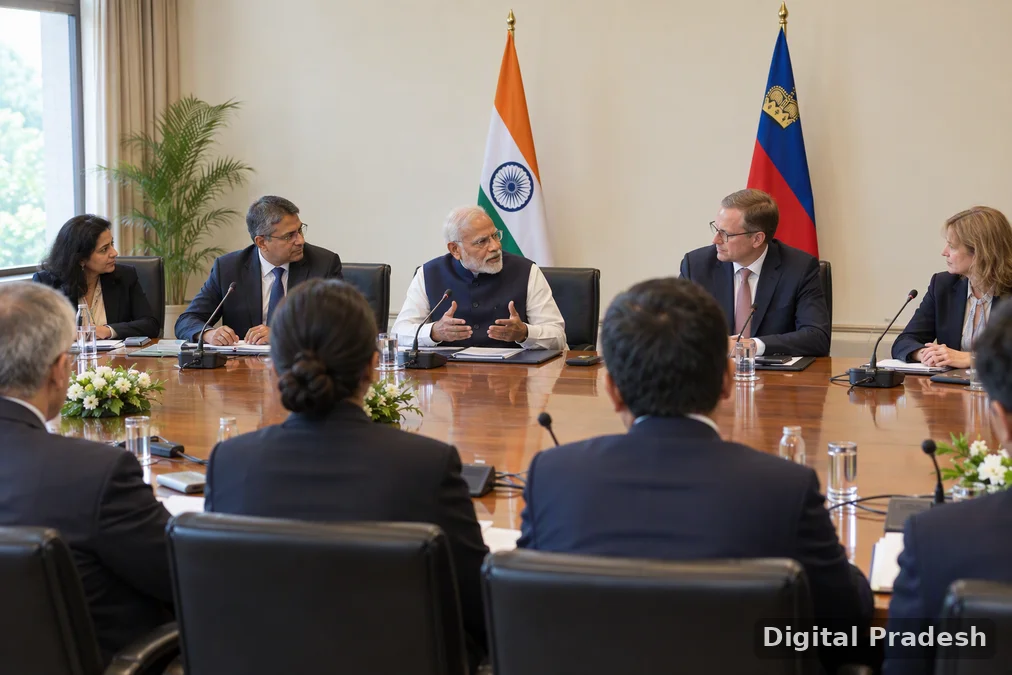
Prime Minister Narendra Modi and Liechtenstein’s Hereditary Prince Alois discussed investment opportunities and reviewed progress under the India-EFTA Trade and Economic Partnership Agreement, according to the Prime Minister’s Office. Its account said the agreement had completed its first year and that the leaders discussed strengthening bilateral relations across several sectors.
The investment discussions concern an agreement whose commitments extend well beyond Liechtenstein. The European Free Trade Association (EFTA) comprises Switzerland, Norway, Iceland and Liechtenstein. DD News reported that the pact provides a framework for USD 100 billion in investment commitments and the creation of one million direct jobs over 15 years.
Those figures describe the agreement’s long-term commitments, not investment received or jobs already created. The Prime Minister’s Office did not give investment or employment totals in its account of the leaders’ review, or identify a new project agreed at their meeting.
The talks formed part of a wider programme of economic engagement. In a report published on 27 October 2026, DD News said Alois was visiting India from 25 to 28 October. It described this as his second visit to India in 2026, following his participation in the AI Impact Summit in New Delhi in February.
Business delegation joins investment discussions
A separate meeting in New Delhi brought together Minister of State for Commerce and Industry Jitin Prasada and Liechtenstein’s Deputy Prime Minister Sabine Monauni, who also holds the foreign affairs, environment and culture portfolios, DD News reported. Their discussions covered bilateral economic relations and opportunities for trade and investment cooperation.
A business delegation from Liechtenstein participated in that meeting. According to DD News, it included representatives of the Liechtenstein Chamber of Industry and Commerce, LGT India, Hilti, Savannah Seeds, Liechtenstein Languages, Open Cosmos Ltd. and Lightrock.
Prasada discussed opportunities for Liechtenstein-based companies to expand their presence and investments in India, the broadcaster reported. He invited partnerships with Indian businesses and presented India’s market, workforce, infrastructure and policy environment as reasons for companies to invest.
These were the minister’s arguments for investment, rather than announcements of corporate spending. DD News identified technology, innovation, financial services and manufacturing as areas in which the two sides explored cooperation, but its report did not specify project values or company investment schedules.
The talks also followed the India-EFTA Prosperity Summit 2026 in New Delhi earlier in October. DD News, citing a Ministry of Commerce and Industry press release, reported that the summit had provided further momentum to economic relations between India and the EFTA countries.
What the trade agreement covers
The Trade and Economic Partnership Agreement, or TEPA, links trade access with investment commitments. Reporting on the agreement’s signing, Bloomberg, in an article carried by SWI swissinfo.ch, said the four European countries would gain easier access to India’s market while Indian exporters and service providers would gain access to theirs.
EFTA is distinct from the European Union: Bloomberg described its four members as countries outside the EU. The investment figures associated with TEPA therefore concern this four-country grouping, not the wider European Union or Liechtenstein alone.
At the signing, Commerce and Industry Minister Piyush Goyal said the investment commitments would come from the private sector, Bloomberg reported. That distinction matters to the current discussions with businesses: the USD 100 billion figure is not described in that reporting as a government payment to India.
Bloomberg’s account identified processed food and beverages, electrical machinery, pharmaceuticals and medical devices among the European industries expected to benefit from the pact. It also reported improved access for Indian rice and other products, alongside phased reductions affecting high-end Swiss watches sold in India.
The agreement’s scope extends to services, according to Bloomberg. Its reporting described commitments by EFTA countries to market access and non-discriminatory treatment for Indian services in areas including audio-visual work, accounting and auditing, legal services and computer-related services.
India, in turn, offered access and non-discriminatory treatment in areas including accounting, health, computer services, banking and insurance, Bloomberg reported. These provisions concern the conditions under which services can be supplied; they are separate from the headline investment and employment commitments.
First-year review leaves delivery figures open
The two accounts of the October engagement describe discussions at different levels. The Prime Minister’s Office reported a review of the agreement’s progress by Modi and Alois. DD News described ministerial talks with a business delegation about opportunities to expand investment and commercial partnerships.
Neither account supplied a first-year breakdown of investment attributable to TEPA, jobs created under it or progress against the 15-year commitments. The Prime Minister’s Office also did not identify which measures of progress the leaders examined.
For the businesses represented at the ministerial meeting, the documented agenda was expansion and cooperation in India. Whether those discussions produce specific investments, and how much of the agreement’s investment and employment commitments has been delivered, remain unaddressed in the published accounts.

Please log in to leave a comment.


