24 wetlands in Assam: Centre approves Rs 692.05 crore
The approved programme covers 24 wetlands in Assam's Brahmaputra River system and aims to improve floodwater storage and aquatic habitats; release amounts and a completion deadline are not specified.
In this article
Listen to this article
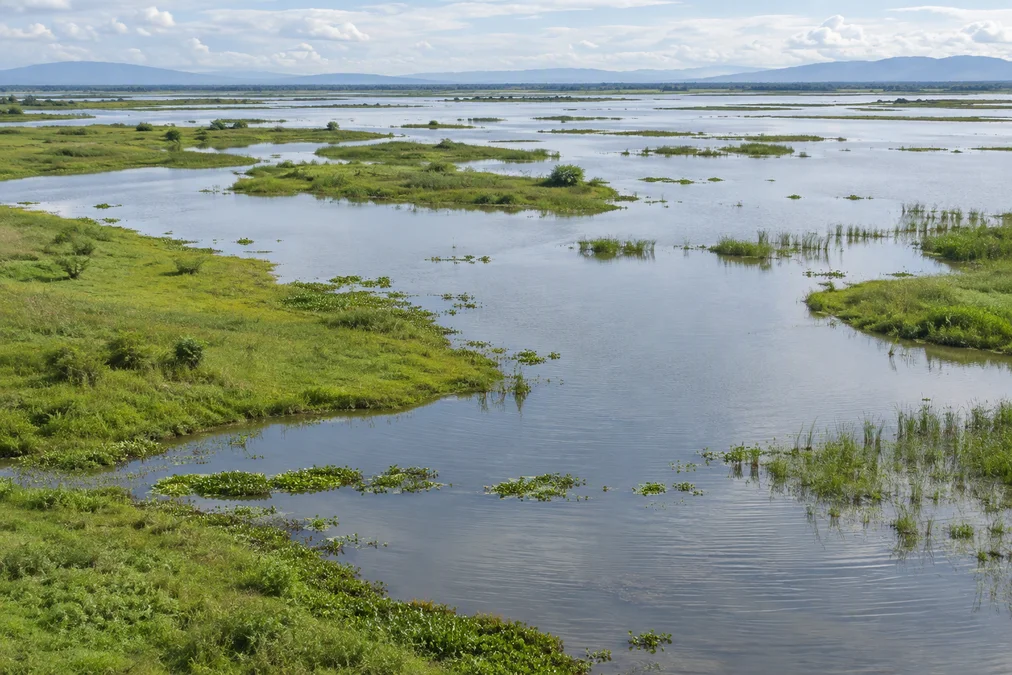
The Union government has approved Rs 692.05 crore for the restoration and rejuvenation of 24 wetlands across nine districts of Assam’s Brahmaputra River system, according to the Ministry of Home Affairs. The ministry lists the programme among projects approved under the National Disaster Mitigation Fund, which supports measures to reduce disaster risk.[1]
The project aims to increase the wetlands’ capacity to hold floodwater, strengthen flood resilience and protect the aquatic environment. Improved fisheries infrastructure is also an intended economic benefit, according to the ministry’s disaster-management schemes page.[2]
The ministry’s programme summary does not specify the approval date, a completion deadline or the amount released. It records an approved financial outlay, rather than expenditure incurred or restoration work completed.[1]
Restoring water storage, not just repairing flood damage
Assam’s Water Resources Department describes the approach in its request for proposals for wetland-restoration consultancy services. The department proposed using selected low-lying areas to store floodwater and reduce flood impacts in the Brahmaputra Valley and its tributaries.[3]
The document sets out four connected objectives: reducing flood risk, controlling erosion, restoring biodiversity and supporting sustainable livelihoods. Its proposed measures include improving water storage, restoring vegetation to stabilise riverbanks, reintroducing native species and involving local communities in wetland management and conservation.[3]
This is a preventive approach. The department’s stated purpose is to improve how wetlands retain water and function ecologically, rather than simply restore infrastructure after a flood. The document treats flood management and ecological restoration as parts of the same project, although these remain objectives rather than demonstrated results.[3]
The consultancy requirements show the technical work envisaged before detailed interventions could be settled:
| Work specified | Purpose in the department’s plan |
|---|---|
| On-field assessment | Evaluate the condition of selected wetlands |
| Hydrological surveys and feasibility studies | Examine water behaviour and assess proposed interventions |
| Concept papers and a draft detailed project report | Develop the project proposals |
| Final detailed project report and clarifications | Support scrutiny by state and central government agencies |
These responsibilities are set out in the Water Resources Department’s procurement document. A detailed project report, or DPR, is the document through which the proposed work is developed for appraisal and approval.[3]
The tender schedule listed 18 January 2025 as the deadline for bids and specified a 24-month completion period for the consultancy service. That period should not be read as the deadline for completing the entire Rs 692.05 crore restoration programme; the document does not establish that connection or confirm a consultancy award.[3]
State proposal and central approval differ in scope
A dated state-level record provides part of the project’s planning history. At its meeting on 3 February 2025, Assam’s State Executive Committee approved a DPR covering 16 wetlands for submission to the Government of India for mitigation funding. The annexure to the minutes lists a total proposed cost of Rs 634.83 crore.[4]
That state submission is not identical to the central ministry’s account of an approved programme covering 24 wetlands at Rs 692.05 crore. The documents establish different scopes and amounts but do not explain how the state proposal was revised or how its individual components map to the centrally approved programme.[4][1]
The state annexure nevertheless illustrates the proposed method. It listed Rs 76.78 crore for increasing the capacity of Maijan wetland upstream of Dibrugarh town, Rs 33.93 crore for augmenting storage at Nanai Beel for flood regulation of the Baghjan river, and Rs 17.57 crore for wetland storage at Vokoti in Majuli to mitigate flooding from the Tuni river. These are figures from the state-approved submission, not confirmed allocations within the central package.[4]
The committee also required changes to the proposal. Citing mitigation-fund guidelines, it said large-scale interventions such as flood embankments were not to be financed from that fund and directed the department to propose water-retention and sediment-control bunds instead.[4]
It further sought justification for including the Rs 5.69 crore Mansiri wetland component, referring to a Rs 10 crore lower limit for structural projects financed from the national fund. The committee directed that at least 10 per cent of the project component should comprise non-structural measures, meaning measures other than physical construction, while keeping the overall proposal within the earlier concept-note ceiling of Rs 714 crore.[4]
Those directions describe requirements at the state appraisal stage. The minutes do not establish how each was addressed in the approved central programme.
Ecological management alongside flood works
The broader wetland-management framework also gives ecological considerations a role beyond water-storage engineering. In its 2020 guidelines for implementing the Wetlands (Conservation and Management) Rules, 2017, the Ministry of Environment, Forest and Climate Change set out responsibilities for state wetland authorities, including reviewing integrated management plans and coordinating their implementation.[5]
The guidelines call for consideration of traditional uses that are compatible with a wetland’s ecological character. They also provide for identifying permitted and regulated activities and raising awareness among local communities. This supplies a management context for Assam’s stated objectives of combining flood mitigation with biodiversity and livelihoods; it does not establish the notification status or regulatory requirements of each project site.[5][3]
The central programme summaries leave several implementation questions open: the final wetland-wise allocation, the additional water-storage capacity expected, the construction schedule and the arrangements for maintaining restored sites. They identify the intended flood-resilience and fisheries benefits, but provide no quantified targets against which those outcomes can yet be assessed.[1][2]
References
- Ministry of Home Affairs. Important Developments, Initiatives and New Schemes in Respect of Disaster Management Division.
- Ministry of Home Affairs, NDM India. Schemes.
- Water Resources Department, Government of Assam. Request for Proposal for Engagement of Empanelled Consultants: Restoration and rejuvenation of wetlands of Assam to enhance the water retention capacity and to mitigate the risks of flooding and erosion.
- Assam State Disaster Management Authority. Minutes of the 52nd State Executive Committee (SEC) Meeting held on February 3, 2025. 5 February 2025.
- Ministry of Environment, Forest and Climate Change. Guidelines for implementing Wetlands (Conservation and Management) Rules, 2017. 2020.

Please log in to leave a comment.


