O-Health: Secures strategic funding for AI and hardware
O-Health has raised an undisclosed amount from investors including Sangita Reddy and Varun Dua to develop clinical AI models and hardware and expand healthcare deployments.
In this article
Listen to this article
O-Health has secured strategic funding from investors including Apollo Hospitals’ Sangita Reddy, Singapore-based BugleRock Capital, Perpetual Capital and ACKO’s Varun Dua to develop its artificial intelligence models and clinical hardware, according to ET ElectronicsWorld’s report published on 7 November 2026. The healthcare technology company did not disclose the amount raised.
O-Health said the investment would support product engineering, manufacturing readiness and commercial expansion across public and private healthcare institutions, ET ElectronicsWorld reported. The company also intends to move beyond its initial focus on gathering patient information before outpatient consultations into connected clinical devices, preventive health technology and AI-enabled patient monitoring.
The funding backs a model of clinical AI built to operate within healthcare institutions. According to ET ElectronicsWorld, O-Health said a priority would be giving institutions greater control over data processing, infrastructure and deployment.
From patient accounts to structured information
O-Health’s existing product is a voice-first clinical pre-assessment platform, according to ET ElectronicsWorld. This means it uses spoken accounts to gather information before a patient sees a doctor, rather than requiring all information to be entered through a written form.
The platform is designed to capture a patient’s account, ask follow-up questions relevant to that account and organise the conversation into clinical information for the doctor, the publication reported. O-Health’s stated aim is to reduce repetitive information gathering and help clinicians review relevant details more efficiently ahead of a consultation.
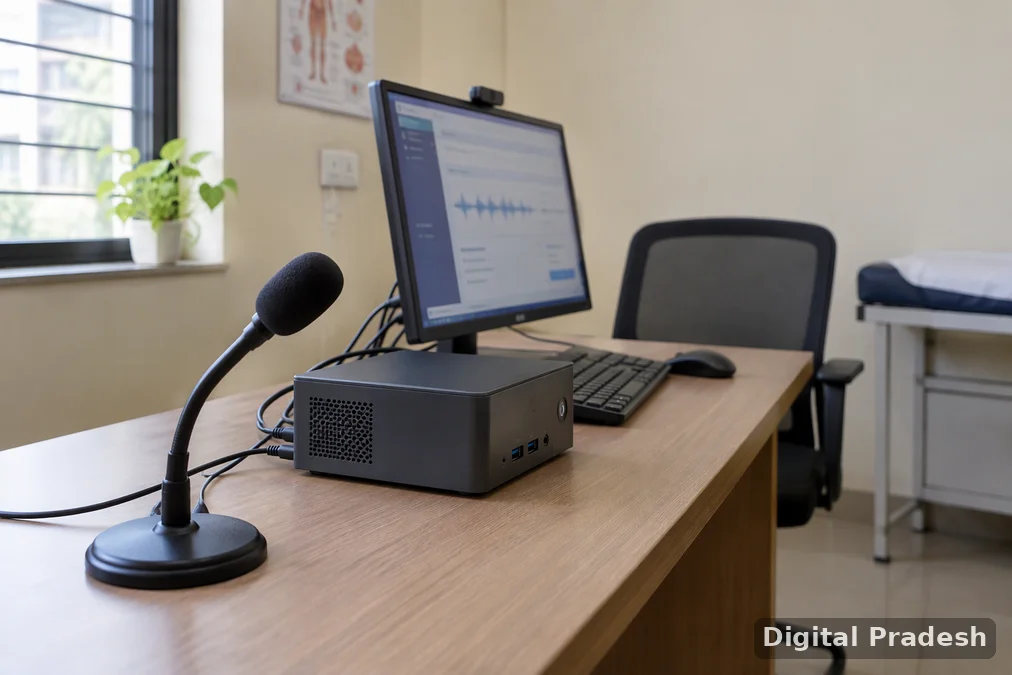
Digital Health News described the platform as producing structured clinical notes and assessment reports from doctor-patient conversations in real time. Its report said the underlying technology combines a proprietary medical speech recognition system with small language models, or SLMs, rather than relying on large foreign AI models or paid external application programming interfaces.
An application programming interface, or API, is a way for one software system to use another system’s services. In the architecture described by Digital Health News, O-Health instead uses its own speech recognition and language models to process the clinical conversation.
These reports describe information gathering and documentation functions. ET ElectronicsWorld’s account places the initial product specifically before the outpatient consultation, with organised patient information prepared for a clinician’s review.
Processing inside hospitals and clinics
Digital Health News reported that O-Health’s models run on hardware installed inside hospitals and clinics. This is the meaning of “edge AI” in the company’s offering: processing takes place locally rather than depending on a distant cloud server.
According to Digital Health News, that architecture is designed to keep patient data on site, reduce response latency – the delay before a system returns an answer – and maintain functionality when internet connectivity is disrupted. The publication identified district hospitals and rural healthcare facilities as settings where that continuity could matter.
The distinction is relevant to what the funding will pay for. O-Health is developing both the AI models and the clinical hardware needed to run them, rather than only a remotely accessed software service, according to the funding reports. ET ElectronicsWorld said the investment would also support manufacturing readiness, putting the physical equipment alongside software development in the company’s expansion plans.
Local processing is the intended operating approach described in those reports. They do not provide measured response times, results from connectivity-interruption tests or a detailed account of how patient data is protected.
Funding for deployments and a wider product range
O-Health said the capital would help fulfil its existing order book and expand deployments in public and private healthcare, according to Elets eHealth. That report also identified Apollo Hospitals Joint Managing Director Sangita Reddy, BugleRock Capital, Perpetual Capital and Varun Dua among the backers.
Elets eHealth additionally named Curefoods’ Ankit Nagori as an investor, attributing its investor list to Moneycontrol. ET ElectronicsWorld’s account named a Delhi-based family office and other investors without identifying that office. Neither account disclosed the size of the investment or an allocation of funds between research, hardware development and deployment.
The proposed product expansion extends beyond the current pre-assessment tool. ET ElectronicsWorld reported that O-Health intends to develop preventive health technologies, connected clinical devices, intelligent hospital workflows and AI-enabled patient monitoring. These are stated development plans, not confirmation that all those products are already available.
Deployment figures and research claims
Founded by Arunoday Singh and Akshar KR, O-Health has said its platform has completed more than 50,000 clinical consultations, according to Elets eHealth. The publication reported deployments at private hospitals including Yashoda Medicity in Delhi NCR.
Elets eHealth also reported a research collaboration with MIT’s Computer Science and Artificial Intelligence Laboratory and a grant from the Gates Foundation. In the statement carried by ET ElectronicsWorld, O-Health described its development as progressing from a rural healthcare prototype through MIT research collaboration, clinical validation at AIIMS New Delhi and expansion across healthcare institutions.
The consultation total is a company-reported usage figure. While O-Health referred to clinical validation at AIIMS New Delhi, ET ElectronicsWorld’s report did not give the study design, patient sample, performance measures or results needed to assess that validation.

Please log in to leave a comment.