ACME Solar: Ministry of Power authorises line, 25-year term
The Ministry of Power has authorised ACME Solar to lay a 220 kV transmission line across Karnataka and Andhra Pradesh. Required consents and electrical inspection approval remain conditions before operation.
In this article
Listen to this article
The Ministry of Power has authorised ACME Solar Holdings Limited to lay an overhead transmission line serving its 350 MW solar and 175 MW battery energy storage project in Tumkur, Karnataka. Order S.O. 5770(E), dated 21 October 2026 and published in the Gazette of India on 23 October 2026, grants the company powers under Section 164 of the Electricity Act, 2003, for 25 years.
The order goes beyond recording an application: it confers statutory powers for installing the specified line, subject to consents, regulatory compliance and electrical inspection. The ministry has authorised a route through parts of Karnataka and Andhra Pradesh, connecting ACME’s generation switchyard at Ettinahalli village to the Tumkur (Pavagada) inter-state transmission system substation.
Section 164 allows the government to confer powers relating to the placement of lines and posts that a telegraph authority possesses under the Indian Telegraph Act, 1885. The Ministry of Power’s procedure for obtaining this authorisation explains that these powers can be granted for electricity transmission, subject to government-imposed conditions and restrictions.
The October order does not establish that the transmission line or the solar and battery project has begun operating. It expressly requires approval from the Central Government’s Electrical Inspector or Chief Electrical Inspector before ACME operates the line.
A 220 kV connection across two states
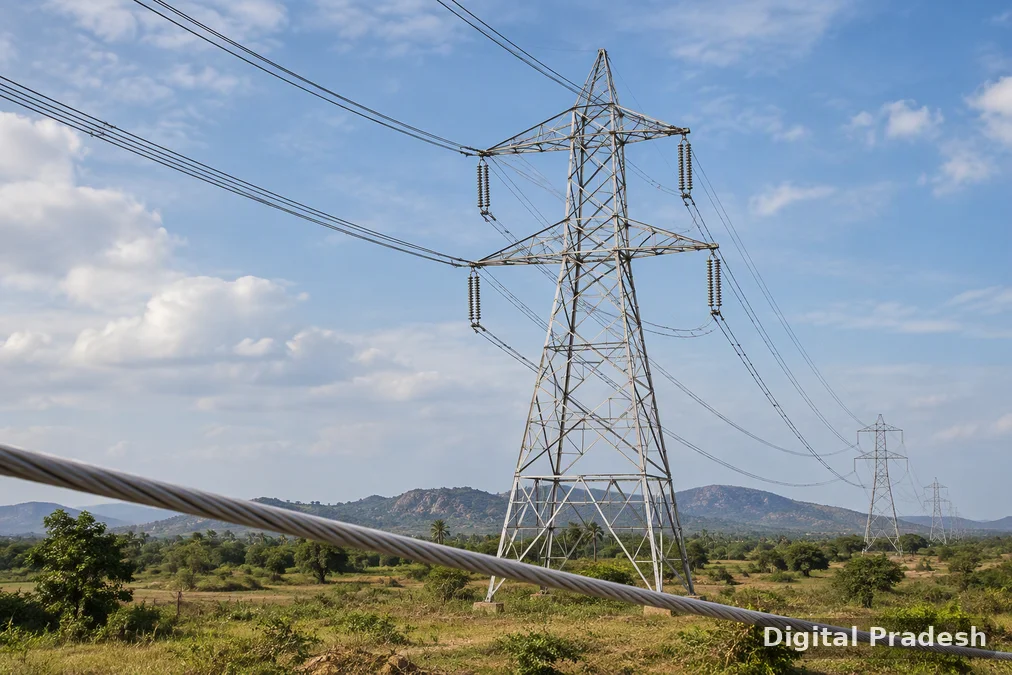
The Gazette order describes the connection as a 220 kilovolt single-circuit line carried on double-circuit towers. It specifies that conductors will be strung on both arms of the towers and bunched at both ends, allowing the line to connect through a single 220 kV line bay at each end. A line bay is the equipment arrangement through which a transmission line connects to a switchyard or substation.
The starting point is ACME’s generation switchyard in Ettinahalli, in Pavagada tehsil of Tumkur district. The destination is identified in the order as the Tumkur (Pavagada) PS inter-state transmission system substation. The authorised infrastructure is therefore the connection between the generating project and the transmission network, rather than the solar generating facilities themselves.
According to the ministry’s route schedule, the Karnataka section passes through, over, around or between settlements in Pavagada tehsil. Listed places include Ponnasamudra, Soolanayakanahalli, Kamanadurga, Rampete, Bhupur and Eguvapalli.
The Andhra Pradesh section covers settlements in Ramagiri mandal of Sri Sathya Sai district. The schedule names Kurakulapalli, Peddakondapuram, Kondapuram, Chinna Kondapuram and Makkinavaripalli. The order provides a settlement-level route description, but does not state the line’s total length or identify individual tower locations.
The ministry describes the connected project as comprising 350 MW of solar capacity and 175 MW of BESS, meaning battery energy storage system. It does not specify the battery’s energy capacity or storage duration, or give a commissioning date for either the project or the line.
Earlier approval and the public-notice process
The October authorisation follows an earlier approval recorded in the same order. The Ministry of Power granted prior approval for laying the overhead line under Section 68(1) of the Electricity Act through a letter dated 28 April 2026. That approval and the subsequent conferral of Section 164 powers are separate steps in the chronology set out by the ministry.
The order states that ACME published notices about the transmission scheme on 15 May 2026 in The New Indian Express, Daily Hindi Milap, Andhra Jyothi, Praja Sakthi, Vijayavani and Vijayakarnataka. A notice also appeared in the Weekly Gazette of India on 13 June 2026. The notices invited public observations or representations on the proposed route within two months of publication.
The ministry records that ACME subsequently submitted an affidavit dated 6 October 2026. In that affidavit, the company declared that it had received one objection, observation or representation from GR Infra during the stipulated period, and that it had replied to and closed the matter.
That account is ACME’s declaration as recorded by the ministry. The order does not reproduce GR Infra’s representation, explain its substance or set out ACME’s response.
The Ministry of Power’s published Section 164 procedure explains the purpose of this consultation stage. It requires applicants to consider objections and representations before finalising the route alignment and to submit a certificate to that effect with their application.
The procedure also calls for newspaper publications, authenticated route maps and justification for the selected alignment to be submitted to the Central Electricity Authority. Its acknowledgement of receiving those documents is to accompany the application to the ministry.
Consents and inspection remain conditions
The authorisation requires ACME to obtain consent from the relevant authorities before erecting the proposed line. The ministry specifically identifies local bodies, Railways, National Highways and State Highways among those authorities.
ACME must also comply with the appropriate electricity commission’s regulations and codes governing transmission, operation and maintenance, and open access, which concerns use of the electricity network. The order separately makes the approval conditional on compliance with the Electricity Act and rules made under it.
At electrical inspection, ACME must submit the requisite clearances from authorities such as Civil Aviation and Defence to the Central Electricity Authority. The Gazette order does not record whether those clearances and the other required consents have already been obtained; operation of the line remains subject to the specified electrical inspector’s approval.

Please log in to leave a comment.


