Bengaluru-Mumbai Vande Bharat Sleeper: Launched, runs overnight
The Bengaluru-Mumbai Vande Bharat Sleeper connects SMVT and CSMT in about 16 hours, with separate weekly breaks in each direction.
In this article
Listen to this article
Prime Minister Narendra Modi has highlighted the Bengaluru-Mumbai Vande Bharat Sleeper as an improvement in interstate rail connectivity, saying it would benefit young people, IT professionals and students across Karnataka, Andhra Pradesh and Maharashtra, according to a statement from the Prime Minister’s Office.
The statement emphasised more convenient travel between the two cities. Railway Minister Ashwini Vaishnaw flagged off the inaugural service from Bengaluru on 1 November, News18 reported. Regular departures were scheduled to begin from Mumbai on 2 November and from Bengaluru on 3 November, according to Mathrubhumi.
The inaugural journey differed from the regular timetable: the special launch service had a different arrival time and additional stops, Mathrubhumi reported. The regular overnight service connects Sir M Visvesvaraya Terminal in Bengaluru, known as SMVT, with Chhatrapati Shivaji Maharaj Terminus in Mumbai, or CSMT.
Overnight timetable and weekly breaks
According to Mathrubhumi, train number 27652 is scheduled to leave Bengaluru at 7.45 pm and reach Mumbai at 11.55 am the following day. In the opposite direction, train number 27651 is scheduled to depart Mumbai at 8.10 pm and arrive in Bengaluru at noon the next day.
Those published timings give a scheduled journey of 16 hours and 10 minutes towards Mumbai and 15 hours and 50 minutes towards Bengaluru, calculated from the departure and arrival times reported by Mathrubhumi. News18 compared the approximately 16-hour journey with around 22 to more than 24 hours on several existing trains.
Mathrubhumi reported that the service would run six days a week in each direction, with no departure from Bengaluru on Mondays and none from Mumbai on Tuesdays. These are separate weekly breaks, rather than a single non-operating day for both directions.
The regular stops from Bengaluru towards Mumbai are Anantapur, Guntakal, Raichur, Yadgir, Kalaburagi, Solapur, Pune and Kalyan, according to News18. That route explains the Prime Minister’s reference to benefits across three states, rather than only to passengers travelling between the two terminal cities.
Mathrubhumi reported that Hindupur, Dharmavaram and Lonavala were additional stops for the inaugural special. They were not included in the regular service’s stop list.
Accommodation, fares and operations
South Western Railway will operate and maintain the service using two dedicated trainsets on the Bengaluru-Mumbai-Bengaluru route, News18 reported.
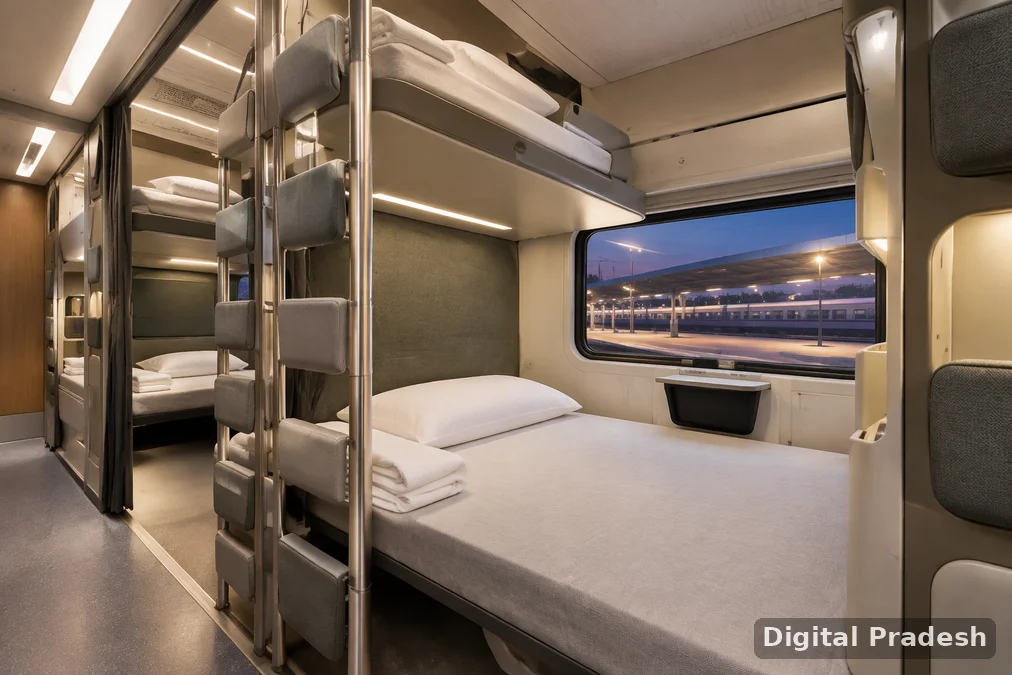
Mathrubhumi put the train’s composition at 16 air-conditioned coaches: one AC First Class coach, four AC 2-Tier coaches and 11 AC 3-Tier coaches. The sleeper accommodation distinguishes it from the seated Vande Bharat services developed for intercity journeys.
News18 reported full-journey fares from Bengaluru to Mumbai of Rs 2,810 in AC 3-Tier, Rs 3,630 in AC 2-Tier and Rs 4,450 in AC First Class. The report attributed its fare information to the Indian Railway Catering and Tourism Corporation, or IRCTC.
Bookings opened at 8 am on 31 October, according to News18. Citing IRCTC availability information from that date, the publication reported that AC 2-Tier and AC First Class were fully booked for the first regular departure from Bengaluru. That booking snapshot describes availability at the time, not the position for later journeys.
South Western Railway said the service would offer a comfortable overnight option and improve connectivity between Karnataka and Maharashtra, according to Mathrubhumi. At the launch, Vaishnaw described the connection as linking Bengaluru’s IT and startup economy with Mumbai’s financial centre, the publication reported.
How the sleeper fits into the wider programme
The Press Information Bureau’s backgrounder on Vande Bharat and intercity rail modernisation, dated 16 January 2026, described the sleeper variant as an extension of the platform into long-distance overnight travel. It identified Howrah-Guwahati as the planned first sleeper corridor at that stage.
The same document described Vande Bharat as an indigenously developed, self-propelled trainset: an integrated train system rather than coaches pulled by a separate locomotive. Its account of the sleeper programme said trial runs, testing and certification had been completed, including high-speed trials on the Kota-Nagda section and long-distance performance trials on the Mumbai-Ahmedabad corridor.
Those test results are distinct from a passenger timetable. In a Rajya Sabha answer dated 25 July 2025, the Ministry of Railways said average train speed depends on track geometry, stops along the route and maintenance work. The ministry distinguished the then-running Vande Bharat trains’ design speed of 180 kmph from their maximum operating speed of 160 kmph.
For the Bengaluru-Mumbai service, the reported departure and arrival times therefore provide the relevant journey comparison, rather than a trainset’s maximum tested speed.
Separate proposal through Hubballi
Vaishnaw also announced another Vande Bharat Sleeper connection from Bengaluru through Hubballi towards Pune and Mumbai, according to both News18 and Mathrubhumi. That proposal is separate from the launched service through Anantapur, Guntakal, Raichur, Yadgir and Kalaburagi.
Mathrubhumi reported that the minister presented the proposed route as a further connection for northern Karnataka. Neither report specified a commencement date or timetable for the Hubballi service.

Please log in to leave a comment.


